


Weight


Registered User
Joined: Sep 1999
Posts: 393
From: Houston Tx

Registered User
Joined: Nov 1998
Posts: 3,252
From: Knoxville, TN
It's not so much as Bob's suggestions were anti-Camaro... it's more that I reckon I know what Bob's intentions will be given his design mandate. Bob's aspirations for Camaro are mainly track oriented, I'm sure. As for the rest of us who would buy Camaro for its relaxed manners, the smallblock's power, the superb balance/ride/handling and steering precision, we're grateful that GM is once again resurrecting the much revered nameplate.
This Camaro shapes up to be the best ever but people are unfairly dismissive given the assumed weight it will carry. Just reiterating, having driven a Zeta V8 Commodore in anger, I can tell you it's a fun drive and I can live with its bulk because I clearly believe it's a non-issue given I won't be racing it down the strip.
Believe it or not but Ford's Mustang doesn't tick all the boxes either. I'm sure many Mustang owners wouldn't care about the drag strip... they love the car for its many other tangible qualities.
This Camaro shapes up to be the best ever but people are unfairly dismissive given the assumed weight it will carry. Just reiterating, having driven a Zeta V8 Commodore in anger, I can tell you it's a fun drive and I can live with its bulk because I clearly believe it's a non-issue given I won't be racing it down the strip.
Believe it or not but Ford's Mustang doesn't tick all the boxes either. I'm sure many Mustang owners wouldn't care about the drag strip... they love the car for its many other tangible qualities.
And if a car is lighter, it will likely have better balance/ride/handling and precision.
Might not have those heated seats and 20 airbags though. Darnit.
Bob

Registered User
Joined: Aug 2001
Posts: 2,400
From: Michigan's left coast
Maybe it costs GM less labor time (hours) to actually build the car today? Also, the economies of scale are far greater for some of the parts the Corvette uses i.e. LSx engines and transmissions... and the architecture is also shared with the XLR. There really isn't much difference b/w the converted price you calculated vs the actual price today. I don't know if place of manufacture of some components is also a factor in reducing overall cost.

Registered User
Joined: Nov 2000
Posts: 16,176
From: Chicagoland IL

Like I said in a post 5 or 10 pages back, a cradle is not required (heavy *** or not) for an IRS. But it's preferred for NVH reasons.
Now, getting back to that 'mass-less' cast metal rear axle housing....
Last edited by Z284ever; Aug 5, 2007 at 12:52 PM.

Registered User
Joined: Jun 2004
Posts: 2,977
From: SeVa

Registered User
Joined: Jun 2004
Posts: 2,977
From: SeVa
Wow, I can't believe I actually read this. Surely the only factor in deciding the weight of an engine is it's displacement and cylinder count, it's configuration (pushrod, SOHC, DOHC) as well as what it's made of doesn't matter! Last I knew the 328i had a 3.0L engine, although it's an inline 6, made of iron and has dual overhead cams it must be half the weight of that big 6.2L pushrod, aluminum, V-engine. 
Another point of interest, and unrelated to BMW, but Ford's WAP 4.6 block weighs a skimpy 80 lbs bare and the prefered TEKSID block weighs a suspension crushing 85 lbs bare.

Thread Starter
Registered User
Joined: Jul 2001
Posts: 3,132
From: Santa Clara, CA
Does the 25 pounds assume both made of aluminum?

Registered User
Joined: Mar 2005
Posts: 3,123
From: Melbourne, Australia
I'm over the charades. What's your point re Camaro? Camaro is not a pure sports car like the Corvette which implies there are some design 'compromises' along the way. Camaro is a car derived from a sedan platform... and it will be cheaper to make than Corvette.
Is that a good enough answer?
Registered User
Joined: Nov 2000
Posts: 16,176
From: Chicagoland IL
No, with a cradle. Without a cradle, the weight difference may even be negliible.
And there are no assumptions about one being light weight materials intensive and the other not.

Registered User
Joined: Mar 2001
Posts: 13,713
From: The Golden State
We can likely expect the same weight gain with a blown "Super Camaro", unless GM sells the car as a "Stripper".... not likely.

I believe this is the type of IRS I believe you're thinking of that doesn't need a cradle, is only a little heavier than a live axle (roughly 25-50 pounds) and/or can be bolted directly to the body. It's the type of trailing arm IRS that I mentioned.

Modern IRS systems attached to unibodies have subframes. True, they help with NVH, but it's also provides a point to mount the lower control arm (can't mount it to the differential), and can me made as a modular unit.


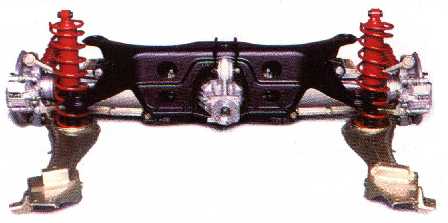


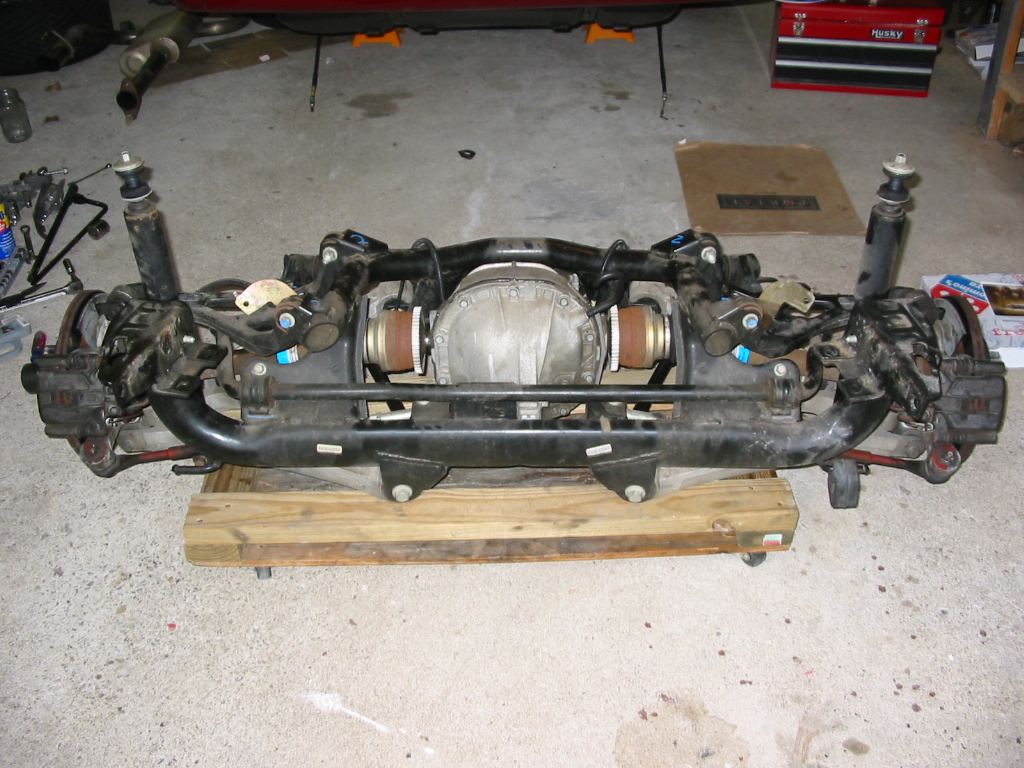
Point is, a subframe is a requirement with modern IRS. That subframe adds substantial weight, and why every modern rear drive car with IRS is substantially heavier than a live axle car with all else the same (I'm going to save the increased expense part for another thread).
If you're going to pump 500 plus horsepower through these things along with the same torque, things are going to need to be pretty tough.
Last edited by guionM; Aug 6, 2007 at 12:07 PM.
Registered User
Joined: Nov 1998
Posts: 3,252
From: Knoxville, TN
With the Mustang GT weiging in at around 3500 pounds and the GT500 weighing nearly 300 pounds more, you can atribute the entire weight gain to the supercharger package, fortified engine & drivetrain parts, and braking componets needed to produce a reliable and warranty safe 500-600 horsepower.
The single biggest hunk of that weight is the 5.4L iron block (vs aluminum 4.6). Add the larger 4V, 4 cam heads (vs 3 Valve with 2 cams), the blower stuff, and the 6 speed, and that is the vast majority of the weight increase - the engine and (to a much lesser extent) the transmission. GM doesn't have those engine issues when comparing their base LS1/2/3 with their top-of-the-line LS7.
The increased braking components are needed, in part, because of the extra weight of the car.
Bob
Thread Starter
Registered User
Joined: Jul 2001
Posts: 3,132
From: Santa Clara, CA
I just wanted to make sure I understood the context.