


LT1 Coolant light radomly comes on


Thread Starter
Registered User
Joined: Mar 2010
Posts: 1
From: Indianapolis, IN
LT1 Coolant light radomly comes on
We are the new proud owners of a 97 Z28 but now the coolant light keeps coming on and going off. Ive researched this everywhere and it seems like this is a common issue. She is full coolant and not leaking any that I have been able to tell. Should I just change the coolant lvl sensor or is there another route I should investigate? I dont want to change it to find out there is a whole different collection of issues i should have done. Any suggestions???

Registered User
Joined: Sep 2004
Posts: 2,595
From: Lenexa, KS
We are the new proud owners of a 97 Z28 but now the coolant light keeps coming on and going off. Ive researched this everywhere and it seems like this is a common issue. She is full coolant and not leaking any that I have been able to tell. Should I just change the coolant lvl sensor or is there another route I should investigate? I dont want to change it to find out there is a whole different collection of issues i should have done. Any suggestions???
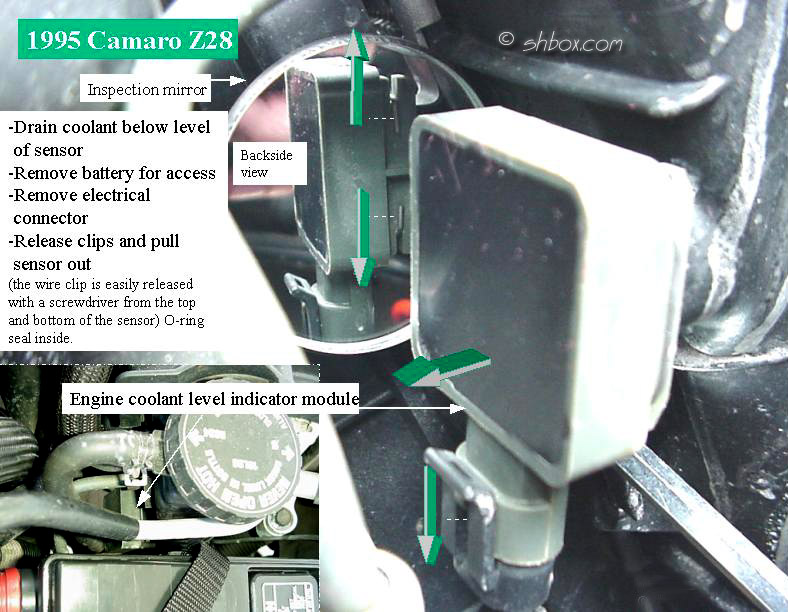
Here's how to replace it, per shoebox's website.

Registered User
Joined: Feb 2010
Posts: 78
From: Houston, TX
Can you elaborate on why the reservoir is not a useful check? I am having a similar issue and was told the sensors is faulty. I was going to change it out, but am in no hurry... I was relying on the "dip stick" and fear I may now be one...

Registered User
Joined: Jul 2007
Posts: 304
From: stockton ca!
most of the time theese sensors get dirty and wont work all that well just pull it off the reservoir and clean it, most of the time you need to get a new one but cleaing it first will save you money.

Administrator
Joined: Nov 1998
Posts: 71,110
From: Hell was full so they sent me to NJ
You have to pop the radiator cap (be careful - when its hot there is high pressure and it may boil) and make sure the coolant is to the top of the radiator, at the edge of the neck where the radiator cap seals. You don't want any air at all in the system, at any time.
As the coolant heats up, it expands, and the cap relives the pressure by letting some of the coolant overflow into the reservoir. When the coolant temperature drops, the coolant contracts, and the resulting vacuum pulls coolant out of the reservoir, into the radiator. If you have a crack in the line between the radiator and the reservoir, the vacuum will be lost, and the system will pull in air, leaving all the coolant in the reservoir - reservoir is "FULL".... radiator now has air in it, and is not "FULL".


Registered User
Joined: Feb 2010
Posts: 78
From: Houston, TX
All the dipstick tells you is that the reservoir is full. The radiator could be empty. The level sensor is in the radiator.
You have to pop the radiator cap (be careful - when its hot there is high pressure and it may boil) and make sure the coolant is to the top of the radiator, at the edge of the neck where the radiator cap seals. You don't want any air at all in the system, at any time.
As the coolant heats up, it expands, and the cap relives the pressure by letting some of the coolant overflow into the reservoir. When the coolant temperature drops, the coolant contracts, and the resulting vacuum pulls coolant out of the reservoir, into the radiator. If you have a crack in the line between the radiator and the reservoir, the vacuum will be lost, and the system will pull in air, leaving all the coolant in the reservoir - reservoir is "FULL".... radiator now has air in it, and is not "FULL".
You have to pop the radiator cap (be careful - when its hot there is high pressure and it may boil) and make sure the coolant is to the top of the radiator, at the edge of the neck where the radiator cap seals. You don't want any air at all in the system, at any time.
As the coolant heats up, it expands, and the cap relives the pressure by letting some of the coolant overflow into the reservoir. When the coolant temperature drops, the coolant contracts, and the resulting vacuum pulls coolant out of the reservoir, into the radiator. If you have a crack in the line between the radiator and the reservoir, the vacuum will be lost, and the system will pull in air, leaving all the coolant in the reservoir - reservoir is "FULL".... radiator now has air in it, and is not "FULL".


Thread
Thread Starter
Forum
Replies
Last Post
Sandersen511
General 1967-2002 F-Body Tech
1
Jan 13, 2015 03:49 PM