


Intake restrictions. How to diagnose.


Thread Starter
Registered User
Joined: Aug 2005
Posts: 4,405
From: Kantuckee Yo'
Another interesting pictorial. This data log was taken during a dyno run last Fall. Note the MAP in purple and the RPM in red. BARO is 100, MAP starts at 99 at low RPM and drops to 92 at high RPM.
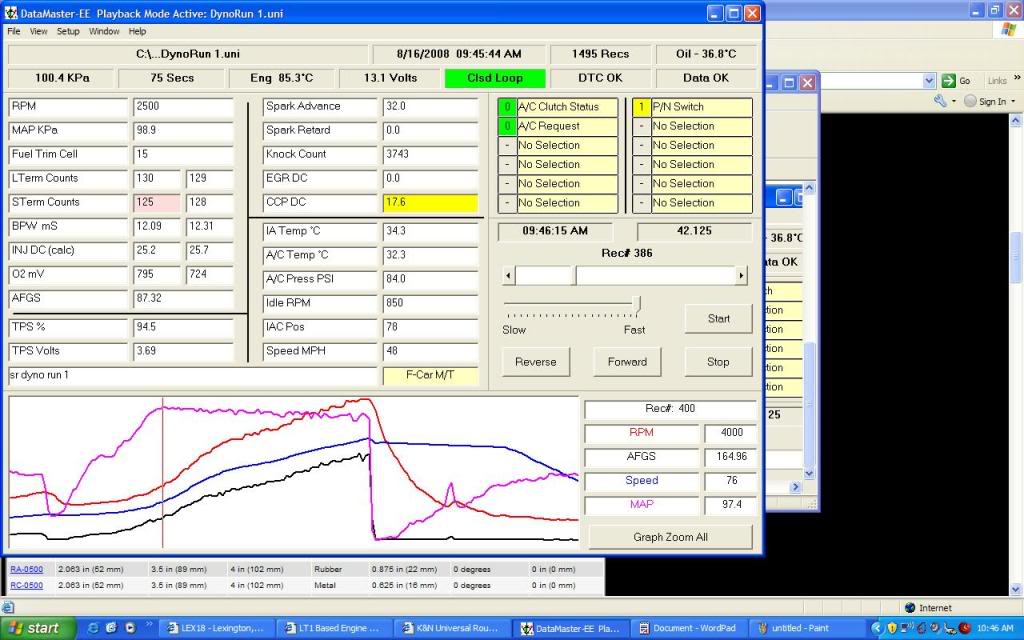
Maybe some other folks out there with Datamaster logs can post their findings.
Maybe some other folks out there with Datamaster logs can post their findings.

Administrator
Joined: Nov 1998
Posts: 71,110
From: Hell was full so they sent me to NJ
I had the Callaway CAI, and it had the "pinch" at the corner of the radiator, but they also made the cross-section a little deeper (longer) where the width narrowed, to eliminate (or at least minimize) the reduction in area. But those changes in shape will cause a pressure loss.
On my data, the "ram air" effect should be minimal, since that was 1st gear and speed wasn't that high.
On my data, the "ram air" effect should be minimal, since that was 1st gear and speed wasn't that high.
Thread Starter
Registered User
Joined: Aug 2005
Posts: 4,405
From: Kantuckee Yo'
I had the Callaway as well, before this AS&M CAI.
Engine builder thinks the filter is too small. I once had a very old CAI made by MTI and it had a enormous K&N filter that was about 9" long. It was pitched a long time ago. I might get that K&N filter, install it and log it to see what happens. I also might be able to move the ABS module back about a bit to allow better flow in the rubber tube.
What I really need now is some nice weather and time to jack around with the datalogger.
Engine builder thinks the filter is too small. I once had a very old CAI made by MTI and it had a enormous K&N filter that was about 9" long. It was pitched a long time ago. I might get that K&N filter, install it and log it to see what happens. I also might be able to move the ABS module back about a bit to allow better flow in the rubber tube.
What I really need now is some nice weather and time to jack around with the datalogger.
Last edited by wrd1972; Mar 15, 2009 at 11:47 AM.

Registered User
Joined: Oct 2001
Posts: 1,517
From: Engineerland
I've made a couple of passes with nothing but the tb hanging out there no maf no nothing trying to figure out where the restriction was. The map looks the same either way when its wound up on mine. Which is why I say its either the tb or some sort of high airflow problem. You can see the though airflow surged right along with the map readings as well so it seems to be a restriction.

Registered User
Joined: Oct 2007
Posts: 220
I can tell when I datalog my car it hardly drops at all. Just the normal little fluctuations. Dropping down to 92KPA shows some loss. I have heard from various sources in my area that a high horsepower LT1 can benefit from a monoblade. Doctor Air and Doctor J here in SoCal as seen from dyno testing.
Thread Starter
Registered User
Joined: Aug 2005
Posts: 4,405
From: Kantuckee Yo'
An udate,
I made a run without the CAI and one with. They both had very similar MAP behavior with the run w/o the CAI being maybe a point better at higher RPM's. Obviously no significant improvment. I also noticed that the filter was a little dirty but not overly dirty.
I did notice that on the run w/o the CAI, the AFGS was higher by about several points at higher RPM's.
NON CAI run on the left. CAI run on the right.
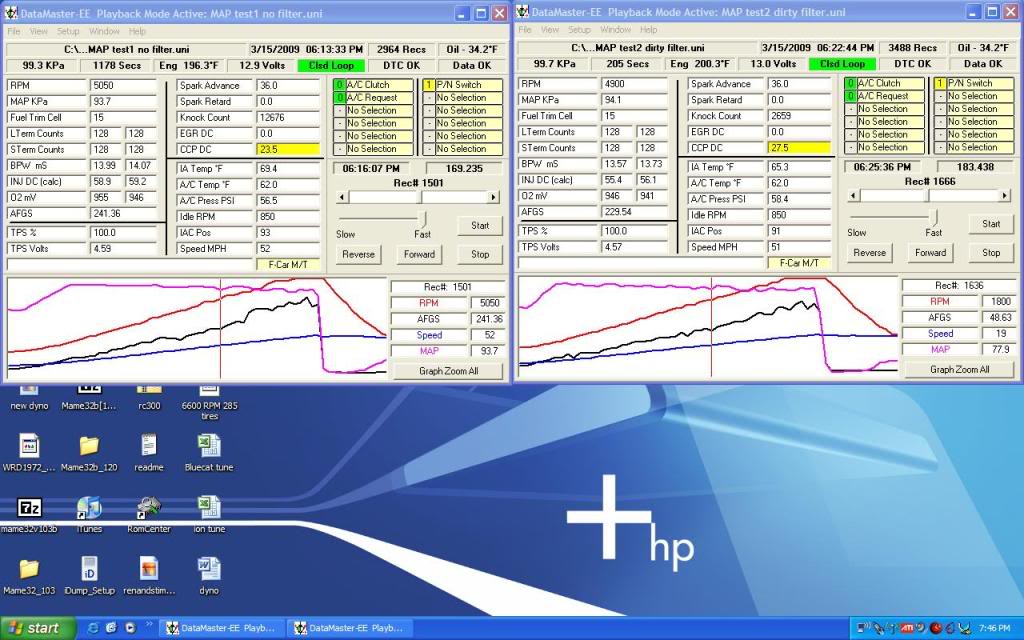
I made a run without the CAI and one with. They both had very similar MAP behavior with the run w/o the CAI being maybe a point better at higher RPM's. Obviously no significant improvment. I also noticed that the filter was a little dirty but not overly dirty.
I did notice that on the run w/o the CAI, the AFGS was higher by about several points at higher RPM's.
NON CAI run on the left. CAI run on the right.
Last edited by wrd1972; Mar 15, 2009 at 07:10 PM.
Registered User
Joined: Oct 2001
Posts: 1,517
From: Engineerland
wrd1972 you can get my email from right under my post count. Just email me the logs, unless someone else is interested in them too.
After thinking about this some more, I think its a volumetric flow problem. Basicly just maxing out what the tb can do handle without increasing the depression pretty drasticly (for wot). If you look at the log I posted the airflow sort of reaches a peak level and hangs there pretty closely unless the pressure differential increases. At room temp conditions the flow for 300g/sec should be about 775cfm and 325 should be about 825cfm. If you notice (loosely) my throttle body at the time couldnt seem to get there without a 7-9kpa difference. Which is a little over 2" hg. If you look where its flowing about 775cfm the depression is about 1.5" hg which is about what you would expect from the 52mm tb I had at the time at 1.5" hg like carbs are tested at. I also have a log of a solid roller 383 I helped with that moves 380g/sec (980cfm) with a monoblade and about 0.5" hg showing on the map (this one had a super vic on it though).
I think the issue may be with some sort of turbulence due to the velocity through the throttle bores or the fact that the throttle body simply cant keep up anymore. After all we are buying throttle bodies based on bore diameter and not flow. If you were buying a carb you'd flip your lid if they told you to choose by throttle bore diameter instead of flow. I think perhaps it would be a whole lot better for all of us if throttle bodies were listed with flow right along with what depression they achieved that flow with. Even with throttle bores being equal flow could vary quite a lot. Things like thinned throttle shafts and the way the bores are contoured in or the way the blades are finished could make a pretty big difference.
After thinking about this some more, I think its a volumetric flow problem. Basicly just maxing out what the tb can do handle without increasing the depression pretty drasticly (for wot). If you look at the log I posted the airflow sort of reaches a peak level and hangs there pretty closely unless the pressure differential increases. At room temp conditions the flow for 300g/sec should be about 775cfm and 325 should be about 825cfm. If you notice (loosely) my throttle body at the time couldnt seem to get there without a 7-9kpa difference. Which is a little over 2" hg. If you look where its flowing about 775cfm the depression is about 1.5" hg which is about what you would expect from the 52mm tb I had at the time at 1.5" hg like carbs are tested at. I also have a log of a solid roller 383 I helped with that moves 380g/sec (980cfm) with a monoblade and about 0.5" hg showing on the map (this one had a super vic on it though).
I think the issue may be with some sort of turbulence due to the velocity through the throttle bores or the fact that the throttle body simply cant keep up anymore. After all we are buying throttle bodies based on bore diameter and not flow. If you were buying a carb you'd flip your lid if they told you to choose by throttle bore diameter instead of flow. I think perhaps it would be a whole lot better for all of us if throttle bodies were listed with flow right along with what depression they achieved that flow with. Even with throttle bores being equal flow could vary quite a lot. Things like thinned throttle shafts and the way the bores are contoured in or the way the blades are finished could make a pretty big difference.

Registered User
Joined: Feb 2004
Posts: 4,800
Carbs have all sorts of crap in the bore affecting flow. Our TBs do not. Hence why dry TBs are sold by bore diameter.
Far as flow stagnating if that were the only thing going on you would expect vacuum to increase not stagnate as well.
Long as you BELIEVE there is problem "X" you will never see problem "Y".
Far as flow stagnating if that were the only thing going on you would expect vacuum to increase not stagnate as well.
Long as you BELIEVE there is problem "X" you will never see problem "Y".
Registered User
Joined: Oct 2001
Posts: 1,517
From: Engineerland
Carbs having an as designed appurtenance to flow doesnt change a thing about an engine making x amount of hp requireing y amount of airflow flow. I dont care what the bore size is or how you get there if it doesnt flow the volume it wont flow the mass required to make the number.
Hell just by thinning the shafts on a holley and working with the blades and screws you can make a decent difference in what it will flow. Even the shape before the booster entry makes a big difference. There are probably several different entries and throttle shaft and blade shapes on the various 58mm tb's how do we know which one flows the most? You're always one to not buy things blindly but this you find acceptable?
Hell just by thinning the shafts on a holley and working with the blades and screws you can make a decent difference in what it will flow. Even the shape before the booster entry makes a big difference. There are probably several different entries and throttle shaft and blade shapes on the various 58mm tb's how do we know which one flows the most? You're always one to not buy things blindly but this you find acceptable?
Registered User
Joined: Feb 2004
Posts: 4,800
My point is due to all the different things in a carb the flow variation from one to the next with a given bore size will be greater than the TBs where the shaft size and screws and such you are worried about add up to a lot less variation than carbs. Variation sure but not as big a one as a carb with different plumbing, boosters, chokes all kinds of crap in the way.
Want to be that picky they should be posting information about the inlets and all, pipe, if so how long, radius etc. it all plays a part.
Want to be that picky they should be posting information about the inlets and all, pipe, if so how long, radius etc. it all plays a part.
Registered User
Joined: Oct 2001
Posts: 1,517
From: Engineerland
I want to be picky, as it sits I have no way to gauge the performance of one tb to the next. All I want is flow numbers in cfm from them and at what depression.
What is the other option, guess and check and just assume it flows a big *** amount of air comparatively because the holes are 6mm bigger (or in my cause just accept it or go monoblade)? I dont care about anything else in the intake tract as that is application/car specific. But if they make and sell a tb how hard is it to put the thing on a bench and say it flows X at this depression. Heaven forbid you be able to compare the flow between manufacturers or even sizes.
What is the other option, guess and check and just assume it flows a big *** amount of air comparatively because the holes are 6mm bigger (or in my cause just accept it or go monoblade)? I dont care about anything else in the intake tract as that is application/car specific. But if they make and sell a tb how hard is it to put the thing on a bench and say it flows X at this depression. Heaven forbid you be able to compare the flow between manufacturers or even sizes.
Registered User
Joined: Oct 2007
Posts: 220
Interesting that AS&M advertises their monoblade at 1300cfm. I would assume that is at 28". IMHO the restriction you have is enough to keep you from potentially reaching 400rwhp with your present setup.
I don't know if it the size or shape of the plenum of the LT1 intake but as I stated earlier dyno testing seems to show that a higher horsepower LT1 benefits from a monoblade.
I don't know if it the size or shape of the plenum of the LT1 intake but as I stated earlier dyno testing seems to show that a higher horsepower LT1 benefits from a monoblade.