


What happened to the Plastic LT1 intake idea?


Banned
Joined: Oct 2002
Posts: 6,518
Re: What happened to the Plastic LT1 intake idea?
Originally Posted by Hot Rod Hawk
I said FAST is working on a plastic SBC http://www.wilsonmanifolds.com/news/12_30_04.jpg intake [it's a carb intake], not a LT1 plastic intake. I'm sure you could just change the bolt pattern just like I did on my "SBC" EFI intake thats bolted to "LT1 HEADS".
THen how would injector bungs and fuel rails be delt with???
THen how would injector bungs and fuel rails be delt with???
I also though, dam how do you get bungs in those things?
Bret


Registered User
Joined: Oct 2002
Posts: 2,931
From: Upstate NY
Re: What happened to the Plastic LT1 intake idea?
Originally Posted by Geoff Chadwick
It isnt for "our rides", but one might be able to adapt it.
The CNC process at that level for a one piece is physically impossible. There is a good reason the LSX is a 3 piece. Getting the insides of the runners with even the best CNC machines would be a nightmare. Then there's the fact that this is a composite - and the "grain" from a solid block would be very different from an injected mold. Some materials suffer heavily from this, some do not. Carbon Fiber, for example, is very strong when pulled lengthwise with the threads, but otherwise is like breaking saltines in half if it isnt done exactly right.
And if you wanted to program even the outside of our intake manifold to be duplicated for fitting purposes (like the plastic mockup engines used all over) you'd be looking at easily 100 hours of programming time and then testing the program once or twice to make sure it was accurate.
Then you'd have to get all the metal threaded inserts in there...
This is VERY difficult no matter how you do it.
The CNC process at that level for a one piece is physically impossible. There is a good reason the LSX is a 3 piece. Getting the insides of the runners with even the best CNC machines would be a nightmare. Then there's the fact that this is a composite - and the "grain" from a solid block would be very different from an injected mold. Some materials suffer heavily from this, some do not. Carbon Fiber, for example, is very strong when pulled lengthwise with the threads, but otherwise is like breaking saltines in half if it isnt done exactly right.
And if you wanted to program even the outside of our intake manifold to be duplicated for fitting purposes (like the plastic mockup engines used all over) you'd be looking at easily 100 hours of programming time and then testing the program once or twice to make sure it was accurate.
Then you'd have to get all the metal threaded inserts in there...
This is VERY difficult no matter how you do it.
You don't even want to know what 100 hours of programming time is worth.
I still think the FAST LSX manifold is underpriced for all the $ they have into design, development and tooling. If they sell enough of them they'll make some money. This is for a current and future production engine.
Building a new composite manifold for the dead (as far as OEM goes) LT1 has probably been studied, but when the costs were amortized over the possible market, the planners quickly shelved (or trashed) the plans.
Hey, if anyone wants to cobble up one themselves the labor is free, as noted above. If it works better than the alternatives, decide how much your labor is worth to duplicate it and look for a market at that price.
It's a little llike the LT1 specific aluminum block for under a grand (or 2 or 5 or ?) thread. Folks in the parts building business know the economics and are getting a good laugh from most of these kinds of threads.
Conversions may continue to be the all around best/economical way for the LT1.

Registered User
Joined: Feb 2000
Posts: 1,248
From: Bountiful, Utah
Re: What happened to the Plastic LT1 intake idea?
Originally Posted by OldSStroker
Listen up, guys. Geoff is telling it as it is.
I still think the FAST LSX manifold is underpriced for all the $ they have into design, development and tooling. If they sell enough of them they'll make some money. This is for a current and future production engine.
.
I still think the FAST LSX manifold is underpriced for all the $ they have into design, development and tooling. If they sell enough of them they'll make some money. This is for a current and future production engine.
.
Straight from the horses mouth!

Registered User
Joined: Oct 1998
Posts: 297
From: Choctaw, OK 73020
Re: What happened to the Plastic LT1 intake idea?
I would think with FAST's involvement that there will certainly be an EFI version of the manifold available so you won't have to worry about how to install injector bungs and fuel rail mounts.
I waiting for more information concerning FAST's new 1300cfm 4150 style throttle body. Below is some information about it. You will have to scroll down.
Website Showing Pic of FAST Throttle Body
It looks an awful lot like Wilson's TB, but Wilson doesn't offer a 1300cfm 4150 flanged throttle body. At least not in their online catalog.
Dave
I waiting for more information concerning FAST's new 1300cfm 4150 style throttle body. Below is some information about it. You will have to scroll down.
Website Showing Pic of FAST Throttle Body
It looks an awful lot like Wilson's TB, but Wilson doesn't offer a 1300cfm 4150 flanged throttle body. At least not in their online catalog.
Dave
Last edited by Dave69Z; Jan 28, 2005 at 05:33 PM.
Registered User
Joined: Feb 2000
Posts: 1,248
From: Bountiful, Utah
Re: What happened to the Plastic LT1 intake idea?
Originally Posted by SStrokerAce
Yep that's it.
I also though, dam how do you get bungs in those things?
Bret
I also though, dam how do you get bungs in those things?
Bret
OR
Call FAST and drop a bug in Jays ear for a EFI version of this intake


Registered User
Joined: Jul 2001
Posts: 752
From: Double Oak TX
Re: What happened to the Plastic LT1 intake idea?
What wrong with just doing a Hogan type sheet metal intake?? Ya…. They are expensive, but the idea sure looks good to me.
I have on my hot list to buy but I'm redoing my engine and only like making so many changes at one time. Really prefer to get it back running properly making sure there are no bugs in the engine redo.
Anyone……. Anyone? Have any experience with them who can give me some insights before I take the leap?
I have on my hot list to buy but I'm redoing my engine and only like making so many changes at one time. Really prefer to get it back running properly making sure there are no bugs in the engine redo.
Anyone……. Anyone? Have any experience with them who can give me some insights before I take the leap?

Registered User
Joined: Nov 2001
Posts: 2,985
From: In a house by the bay
Re: What happened to the Plastic LT1 intake idea?
I had my intake coated by Swain... thermal barrier and dispersant. Is just warm to the touch after driving home from the office in moderate traffic. Next best thing to "plastic" IMO.
Denny,
Yes, I've seen more than a few Hogan intakes. They build a nice one. Then again, so does CFE, Wilson and a few others. If you want something that can retain the stock (or near stock) throttle body mounting position, it's the only way to fly.
-Mindgame
Denny,
Yes, I've seen more than a few Hogan intakes. They build a nice one. Then again, so does CFE, Wilson and a few others. If you want something that can retain the stock (or near stock) throttle body mounting position, it's the only way to fly.
-Mindgame
Registered User
Joined: Jul 2001
Posts: 752
From: Double Oak TX
Re: What happened to the Plastic LT1 intake idea?
Originally Posted by Mindgame
I had my intake coated by Swain... thermal barrier and dispersant. Is just warm to the touch after driving home from the office in moderate traffic. Next best thing to "plastic" IMO.
Denny,
Yes, I've seen more than a few Hogan intakes. They build a nice one. Then again, so does CFE, Wilson and a few others. If you want something that can retain the stock (or near stock) throttle body mounting position, it's the only way to fly.
-Mindgame
Denny,
Yes, I've seen more than a few Hogan intakes. They build a nice one. Then again, so does CFE, Wilson and a few others. If you want something that can retain the stock (or near stock) throttle body mounting position, it's the only way to fly.
-Mindgame
Mindgame
Thank you very much. I'm thinking about having my pistons and heads coated also. Maybe even the bottom of the Hogan when and if it get it. More than likely "when".
Are any of the other companies you mention cheaper than Hogan?? Or do you bascially get what you pay for.

Registered User
Joined: Apr 2002
Posts: 2,154
From: All around
Re: What happened to the Plastic LT1 intake idea?
Hogan makes one, as does someone else, and Bret made a couple impressive pieces as well (SStroker Ace) and they do work. The thing to remember is what the manifold was meant for in the first place. For example, in high end racing engines, they tweak the manifold design, cam, heads etc... freaking everything, every last detail, to work in perfect harmony. Put the pieces of your setup together to function in harmony. A bunch of awesome parts slapped together will get decent results. A bunch of crappy parts put together with a LOT of thought and detail will get awesome results.
For $1500-$2000 for a good manifold, then a custom cam, then tuning etc. - if you're not "stuck" doing a normally aspirated mill, odds are you'll have better advantages doing other mods. The gains from a manifold alone wont get you too much power. Very good gains, sure, but unless you're running a 383 with so much boost you need more flow, or a 396 N/A motor with rediculous heads - there are better ways to spend the dollar.
But then again I have no idea what style setup you have, your limits, your goals, or even your CID.
Knowing FAST put $750,000 into development costs... I'm not suprised. That seems right for the level of detail they went to. You know their accounting manager must have been having a fit! Dumping a quarter million into a manifold that might not sell all that many units?
However, knowing they are working on one that could be adapted to a large elbow and a throttle body, it's only a matter of time before an EFI one comes out. How long? Dont know. I assume they'd need to recover more investment and sell units before making the minor upgrades to convert it to EFI.
For $1500-$2000 for a good manifold, then a custom cam, then tuning etc. - if you're not "stuck" doing a normally aspirated mill, odds are you'll have better advantages doing other mods. The gains from a manifold alone wont get you too much power. Very good gains, sure, but unless you're running a 383 with so much boost you need more flow, or a 396 N/A motor with rediculous heads - there are better ways to spend the dollar.
But then again I have no idea what style setup you have, your limits, your goals, or even your CID.
Knowing FAST put $750,000 into development costs... I'm not suprised. That seems right for the level of detail they went to. You know their accounting manager must have been having a fit! Dumping a quarter million into a manifold that might not sell all that many units?
However, knowing they are working on one that could be adapted to a large elbow and a throttle body, it's only a matter of time before an EFI one comes out. How long? Dont know. I assume they'd need to recover more investment and sell units before making the minor upgrades to convert it to EFI.
Last edited by Geoff Chadwick; Jan 29, 2005 at 10:12 AM.
Registered User
Joined: Nov 2001
Posts: 2,985
From: In a house by the bay
Re: What happened to the Plastic LT1 intake idea?
In the scheme of things, I think Hogan is probably one of the less expensive intake builders. They have a catalog and they have some standard intake designs they build all the time... so they likely have jigs and tools they use to manufacture with. Still hand built but not exactly one-offs, which is in no way a slight to Hogan.... this is great for us as consumers but CFE in particular builds their intakes on a per customer basis for that particular customer's engine. So, the price goes up.
There are guys like Kevin Self (Self Racing Heads) and others who build intakes and perhaps not being a big name (as big) operation, they may give you a better price. You'll just have to shop around and talk to different builders to see what they can do for you.
Good luck.
-Mindgame
There are guys like Kevin Self (Self Racing Heads) and others who build intakes and perhaps not being a big name (as big) operation, they may give you a better price. You'll just have to shop around and talk to different builders to see what they can do for you.
Good luck.
-Mindgame
Banned
Joined: Oct 2002
Posts: 6,518
Re: What happened to the Plastic LT1 intake idea?
Originally Posted by Mindgame
If you want something that can retain the stock (or near stock) throttle body mounting position, it's the only way to fly.
-Mindgame
-Mindgame
Registered User
Joined: Jul 2001
Posts: 752
From: Double Oak TX
Re: What happened to the Plastic LT1 intake idea?
Originally Posted by Mindgame
In the scheme of things, I think Hogan is probably one of the less expensive intake builders. They have a catalog and they have some standard intake designs they build all the time... so they likely have jigs and tools they use to manufacture with. Still hand built but not exactly one-offs, which is in no way a slight to Hogan.... this is great for us as consumers but CFE in particular builds their intakes on a per customer basis for that particular customer's engine. So, the price goes up.
There are guys like Kevin Self (Self Racing Heads) and others who build intakes and perhaps not being a big name (as big) operation, they may give you a better price. You'll just have to shop around and talk to different builders to see what they can do for you.
Good luck.
-Mindgame
There are guys like Kevin Self (Self Racing Heads) and others who build intakes and perhaps not being a big name (as big) operation, they may give you a better price. You'll just have to shop around and talk to different builders to see what they can do for you.
Good luck.
-Mindgame
While the engine is torn apart....... what measurments do they need to do a custom intake. I'll be using the offroad LT4 gaskets and knowing the port is pretty much a given. Block height? What needs to be measured on the heads and how much of a fudge factor is their is it's off a little? (as you know there will be some)

Registered User
Joined: Dec 2003
Posts: 254
From: Charleston, SC
Re: What happened to the Plastic LT1 intake idea?
heh. heres some more info:
http://www.solvayadvancedpolymers.co.../LSX110403.pdf
in the future, if you want to make somthing in "lower volume" mass production, just look at how the other guy is doing it.
Three Companies Partner to Produce the First Injection Molded
Air Intake Manifold for Automotive Performance Aftermarket
Innovative design and production techniques make part stronger than
original-equipment nylon manifold, lighter than aluminum replacement
Alpharetta, Ga. - The new LSX air intake manifold, introduced at the November Specialty
Equipment Manufacturers Association (SEMA) show by Fuel-Air-Spark Technologies (F.A.S.T.), is the
first known composite manifold to be produced for the automotive performance aftermarket. F.A.S.T., a
company in the Competition Cams group of performance parts providers, had two key partners in this
innovative project, along with renowned airflow expert Keith Wilson of Wilson Manifolds.
The new manifold was engineered and designed by Managed Programs, L.L.C. (MPI), and it is
supplied by Composite Performance Technologies, L.L.C. (CPT). These two affiliated companies have
global experience in the creation of composite components for automotive original-equipment
manufacturers.
F.A.S.T. wanted a part that outperformed the stock nylon manifold, but that was not subject to the
weight and heat penalties imposed by a traditional aluminum replacement. The material specified for the
LSX is AMODEL® A-6135 HSL polyphthalamide (PPA) from Solvay Advanced Polymers, L.L.C.
Unique in the aftermarket
The LSX manifold will replace the stock air intake that comes with the eight-cylinder LS1 and
LS6 engines in the current Corvette and in recent models of the Chevrolet Camaro and Pontiac Firebird.
(more)
Add 1 – Innovative composite manifold ...
Through design iterations, Wilson and Managed Programs were able to increase the airflow by 25%.
Manifold design engineer Tim Collins of MPI points out that “we also made the runners longer to
maintain low-end torque for driveability.”
With no modifications, Collins estimates that the LSX will add 20 horsepower to the 360
generally available from the V-8s it is designed to fit. “The three-piece design makes additional tweaking
do-able for the competent enthusiast. Being able to look down the runner at the intake valve, for
example, simplifies the job of port matching, which can account for 50 additional horsepower in a
normally aspirated engine.”
Details in the LSX design will also accommodate techniques that can push engine output beyond
600 hp, such as adding a turbocharger or engine-driven supercharger to pressurize intake air, or including
such combustion enhancements as a nitrous oxide delivery system to the intake setup.
High performance, low volume manufacturing
The innovative multi-layer design allowed CPT to employ manufacturing strategies that make the
low-volume program profitable. The stock part is cast of glass-reinforced nylon 6/6, essentially in one
piece, using the lost core method. The three sections of the LSX, however, can be injection molded in
open molds, taking time and money out of the molding process.
“Low-volume production can be treated in the same way as a high-volume prototype program,”
explains Dan Agnew, President of CPT. “Effectively, we have eliminated the prototype stage, going
directly to tools that will easily produce the number of parts anticipated for many years of production. By
using rapid molded parts to prove the design, by keeping tooling costs down, and by being smart about
the use of production molding equipment and time, we can keep the parts affordable for our customer.”
(more)
Add 2 – Innovative composite manifold ...
A strong choice of material
The selection of AMODEL A-6135 PPA addressed both performance and processing concerns.
Agnew appreciates that the resin gives CPT the option of processing with hot water at high temperatures,
or with hot oil. But operation in the underhood environment is the real measure of the material’s worth.
At high heat and high humidity, the tensile strength of AMODEL A-6135 resin is 20% greater
than that of nylon 6, and significantly higher than the strength of nylon 6/6. “The pressure in a normally
aspirated manifold is less than the surrounding atmosphere,” says Agnew, “but a turbo or supercharger
will boost that pressure to 1.5 or 2 atmospheres. So the added strength is very important.” The flexural
modulus of this AMODEL grade is at least 20% greater than the stiffness of either nylon 6 or 6/6.
AMODEL A-6135 also offers greater resistance than nylon to tensile creep over time, which could cause
air leakage at the manifold’s gaskets.
Resistance to underhood chemicals
AMODEL PPA materials have proven to provide the chemical resistance required in automotive
underhood applications. The manifold, whose top section is molded in a distinctive gray color to indicate
its performance intentions, will be exposed to gasoline, oil, grease, and the other fluids that are common
in an automotive environment. In particular, the AMODEL resin is more resistant than nylon to
degradation from the new long-life coolants.
Lighter, cooler than aluminum
Traditionally, aftermarket performance intakes have been produced in aluminum, using sand
casting. Jay Rohrback, F.A.S.T.’s General Manager, explains that “an aluminum replacement manifold
for these engines weighs 26 pounds, while the LSX delivers better airflow and weighs only 11 pounds.”
(more)
Add 3 – Innovative composite manifold ...
“Aluminum also collects heat from the engine,” adds Rohrback, “warming the intake air. But the
AMODEL material acts as an insulator. So the choice of this material in a composite design, instead of
using cast aluminum, lets us adhere to the three basic rules of automotive performance parts: (1) lighter is
faster; (2) cold air makes more power than warm air; and (3) if you’re going to make more power, you
need stronger components to do it.”
About Solvay Advanced Polymers
Solvay Advanced Polymers, L.L.C. is a subsidiary of Solvay America, Inc., the U.S. holding
company of Solvay S.A. The company produces high-performance polymers that are used in a wide
range of demanding applications in the automotive, aerospace, industrial, foodservice, medical, and
electronics industries worldwide. More information about this and other Solvay Advanced Polymers
products and services can be found on the company's website at www.solvayadvancedpolymers.com.
Solvay S.A. is an international pharmaceuticals and chemicals group with headquarters in
Brussels, Belgium, employing about 30,000 people in 50 countries. In 2002, its consolidated sales
amounted to EUR 7.9 billion generated by its four activity sectors: Pharmaceuticals, Chemicals, Plastics,
and Plastics Processing. Solvay S.A. is listed in the Euronext 100 index of top European companies.
Details are available at www.solvay.com.
About Managed Programs, L.L.C. and Composite Performance Technologies, L.L.C.
Founded in 1997, MPI is a full-service, US-based company that focuses on automotive design,
engineering, and manufacturing of integrated engine systems and underhood components. MPI
specializes in intake and exhaust manifolds, induction systems, covers, and related parts. The company
has offices in four countries, serving clients in the OEM, Tier 1 and 2, Performance Aftermarket, and
Motorsports segments of the automotive industry.
(more)
Add 4 – Innovative composite manifold ...
CPT is an affiliate of MPI in the conception, development, and marketing of automotive
performance systems. CPT brings its resources to bear on the issues associated with low-volume
production of innovative concepts. The company’s products include racing engine, chassis, and tire
systems. It provides prototype fabrication of underhood components, along with design, testing, tooling,
fabrication, and logistics services. Information about MPI is on the web at www.managed-programs.com.
Additional details about CPT can be found at www.cptechonline.com
About Fuel-Air-Spark Technologies (F.A.S.T.)
Organized in 1996 to address computer control issues in high performance applications using fuel
injection, the company today specializes in complete fuel-injection systems. A member of the Comp
Performance Group, F.A.S.T. also offers a full line of fuel system components, such as pumps, regulators,
and filters, as well as assorted ignition components, including distributors, spark plugs, and wires. More
information is available on the web at www.fuelairspark.com.
-30-
Customer Inquiries:
Solvay Advanced Polymers, L.L.C.
4500 McGinnis Ferry Road
Alpharetta, GA 30005-3914
Phone: 800-621-4557 (US only) or 770-772-8200
E-mail: engpolymers@solvay.com
Website: www.solvayadvancedpolymers.com
http://www.solvayadvancedpolymers.co.../LSX110403.pdf
in the future, if you want to make somthing in "lower volume" mass production, just look at how the other guy is doing it.
Three Companies Partner to Produce the First Injection Molded
Air Intake Manifold for Automotive Performance Aftermarket
Innovative design and production techniques make part stronger than
original-equipment nylon manifold, lighter than aluminum replacement
Alpharetta, Ga. - The new LSX air intake manifold, introduced at the November Specialty
Equipment Manufacturers Association (SEMA) show by Fuel-Air-Spark Technologies (F.A.S.T.), is the
first known composite manifold to be produced for the automotive performance aftermarket. F.A.S.T., a
company in the Competition Cams group of performance parts providers, had two key partners in this
innovative project, along with renowned airflow expert Keith Wilson of Wilson Manifolds.
The new manifold was engineered and designed by Managed Programs, L.L.C. (MPI), and it is
supplied by Composite Performance Technologies, L.L.C. (CPT). These two affiliated companies have
global experience in the creation of composite components for automotive original-equipment
manufacturers.
F.A.S.T. wanted a part that outperformed the stock nylon manifold, but that was not subject to the
weight and heat penalties imposed by a traditional aluminum replacement. The material specified for the
LSX is AMODEL® A-6135 HSL polyphthalamide (PPA) from Solvay Advanced Polymers, L.L.C.
Unique in the aftermarket
The LSX manifold will replace the stock air intake that comes with the eight-cylinder LS1 and
LS6 engines in the current Corvette and in recent models of the Chevrolet Camaro and Pontiac Firebird.
(more)
Add 1 – Innovative composite manifold ...
Through design iterations, Wilson and Managed Programs were able to increase the airflow by 25%.
Manifold design engineer Tim Collins of MPI points out that “we also made the runners longer to
maintain low-end torque for driveability.”
With no modifications, Collins estimates that the LSX will add 20 horsepower to the 360
generally available from the V-8s it is designed to fit. “The three-piece design makes additional tweaking
do-able for the competent enthusiast. Being able to look down the runner at the intake valve, for
example, simplifies the job of port matching, which can account for 50 additional horsepower in a
normally aspirated engine.”
Details in the LSX design will also accommodate techniques that can push engine output beyond
600 hp, such as adding a turbocharger or engine-driven supercharger to pressurize intake air, or including
such combustion enhancements as a nitrous oxide delivery system to the intake setup.
High performance, low volume manufacturing
The innovative multi-layer design allowed CPT to employ manufacturing strategies that make the
low-volume program profitable. The stock part is cast of glass-reinforced nylon 6/6, essentially in one
piece, using the lost core method. The three sections of the LSX, however, can be injection molded in
open molds, taking time and money out of the molding process.
“Low-volume production can be treated in the same way as a high-volume prototype program,”
explains Dan Agnew, President of CPT. “Effectively, we have eliminated the prototype stage, going
directly to tools that will easily produce the number of parts anticipated for many years of production. By
using rapid molded parts to prove the design, by keeping tooling costs down, and by being smart about
the use of production molding equipment and time, we can keep the parts affordable for our customer.”
(more)
Add 2 – Innovative composite manifold ...
A strong choice of material
The selection of AMODEL A-6135 PPA addressed both performance and processing concerns.
Agnew appreciates that the resin gives CPT the option of processing with hot water at high temperatures,
or with hot oil. But operation in the underhood environment is the real measure of the material’s worth.
At high heat and high humidity, the tensile strength of AMODEL A-6135 resin is 20% greater
than that of nylon 6, and significantly higher than the strength of nylon 6/6. “The pressure in a normally
aspirated manifold is less than the surrounding atmosphere,” says Agnew, “but a turbo or supercharger
will boost that pressure to 1.5 or 2 atmospheres. So the added strength is very important.” The flexural
modulus of this AMODEL grade is at least 20% greater than the stiffness of either nylon 6 or 6/6.
AMODEL A-6135 also offers greater resistance than nylon to tensile creep over time, which could cause
air leakage at the manifold’s gaskets.
Resistance to underhood chemicals
AMODEL PPA materials have proven to provide the chemical resistance required in automotive
underhood applications. The manifold, whose top section is molded in a distinctive gray color to indicate
its performance intentions, will be exposed to gasoline, oil, grease, and the other fluids that are common
in an automotive environment. In particular, the AMODEL resin is more resistant than nylon to
degradation from the new long-life coolants.
Lighter, cooler than aluminum
Traditionally, aftermarket performance intakes have been produced in aluminum, using sand
casting. Jay Rohrback, F.A.S.T.’s General Manager, explains that “an aluminum replacement manifold
for these engines weighs 26 pounds, while the LSX delivers better airflow and weighs only 11 pounds.”
(more)
Add 3 – Innovative composite manifold ...
“Aluminum also collects heat from the engine,” adds Rohrback, “warming the intake air. But the
AMODEL material acts as an insulator. So the choice of this material in a composite design, instead of
using cast aluminum, lets us adhere to the three basic rules of automotive performance parts: (1) lighter is
faster; (2) cold air makes more power than warm air; and (3) if you’re going to make more power, you
need stronger components to do it.”
About Solvay Advanced Polymers
Solvay Advanced Polymers, L.L.C. is a subsidiary of Solvay America, Inc., the U.S. holding
company of Solvay S.A. The company produces high-performance polymers that are used in a wide
range of demanding applications in the automotive, aerospace, industrial, foodservice, medical, and
electronics industries worldwide. More information about this and other Solvay Advanced Polymers
products and services can be found on the company's website at www.solvayadvancedpolymers.com.
Solvay S.A. is an international pharmaceuticals and chemicals group with headquarters in
Brussels, Belgium, employing about 30,000 people in 50 countries. In 2002, its consolidated sales
amounted to EUR 7.9 billion generated by its four activity sectors: Pharmaceuticals, Chemicals, Plastics,
and Plastics Processing. Solvay S.A. is listed in the Euronext 100 index of top European companies.
Details are available at www.solvay.com.
About Managed Programs, L.L.C. and Composite Performance Technologies, L.L.C.
Founded in 1997, MPI is a full-service, US-based company that focuses on automotive design,
engineering, and manufacturing of integrated engine systems and underhood components. MPI
specializes in intake and exhaust manifolds, induction systems, covers, and related parts. The company
has offices in four countries, serving clients in the OEM, Tier 1 and 2, Performance Aftermarket, and
Motorsports segments of the automotive industry.
(more)
Add 4 – Innovative composite manifold ...
CPT is an affiliate of MPI in the conception, development, and marketing of automotive
performance systems. CPT brings its resources to bear on the issues associated with low-volume
production of innovative concepts. The company’s products include racing engine, chassis, and tire
systems. It provides prototype fabrication of underhood components, along with design, testing, tooling,
fabrication, and logistics services. Information about MPI is on the web at www.managed-programs.com.
Additional details about CPT can be found at www.cptechonline.com
About Fuel-Air-Spark Technologies (F.A.S.T.)
Organized in 1996 to address computer control issues in high performance applications using fuel
injection, the company today specializes in complete fuel-injection systems. A member of the Comp
Performance Group, F.A.S.T. also offers a full line of fuel system components, such as pumps, regulators,
and filters, as well as assorted ignition components, including distributors, spark plugs, and wires. More
information is available on the web at www.fuelairspark.com.
-30-
Customer Inquiries:
Solvay Advanced Polymers, L.L.C.
4500 McGinnis Ferry Road
Alpharetta, GA 30005-3914
Phone: 800-621-4557 (US only) or 770-772-8200
E-mail: engpolymers@solvay.com
Website: www.solvayadvancedpolymers.com
Registered User
Joined: Dec 2003
Posts: 254
From: Charleston, SC
Re: What happened to the Plastic LT1 intake idea?
more intresting stuff:
http://www.globalspec.com/FeaturedPr...xhibitID=16969
Air Intake Manifold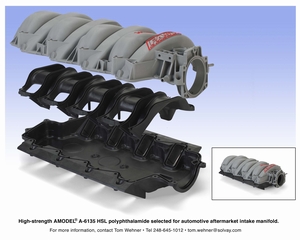
Three Companies Partner to Produce the First Injection Molded Air Intake Manifold for Automotive Performance Aftermarket
Innovative design and production techniques make part stronger than original-equipment nylon manifold, lighter than aluminum replacement
The new LSX air intake manifold, introduced at the November Specialty Equipment Manufacturers Association (SEMA) show by Fuel-Air-Spark Technologies (F.A.S.T.), is the first known composite manifold to be produced for the automotive performance aftermarket. F.A.S.T., a company in the Competition Cams group of performance parts providers, had two key partners in this innovative project, along with renowned airflow expert Keith Wilson of Wilson Manifolds.
The new manifold was engineered and designed by Managed Programs, L.L.C. (MPI), and it is supplied by Composite Performance Technologies, L.L.C. (CPT). These two affiliated companies have global experience in the creation of composite components for automotive original-equipment manufacturers.
F.A.S.T. wanted a part that outperformed the stock nylon manifold, but that was not subject to the weight and heat penalties imposed by a traditional aluminum replacement. The material specified for the LSX is AMODEL® A-6135 HSL polyphthalamide (PPA) from Solvay Advanced Polymers, L.L.C.
Unique in the aftermarket
The LSX manifold will replace the stock air intake that comes with the eight-cylinder LS1 and LS6 engines in the current Corvette and in recent models of the Chevrolet Camaro and Pontiac Firebird. Through design iterations, Wilson and Managed Programs were able to increase the airflow by 25%. Manifold design engineer Tim Collins of MPI points out that “we also made the runners longer to maintain low-end torque for driveability.”
With no modifications, Collins estimates that the LSX will add 20 horsepower to the 360 generally available from the V-8s it is designed to fit. “The three-piece design makes additional tweaking do-able for the competent enthusiast. Being able to look down the runner at the intake valve, for example, simplifies the job of port matching, which can account for 50 additional horsepower in a normally aspirated engine.”
Details in the LSX design will also accommodate techniques that can push engine output beyond 600 hp, such as adding a turbocharger or engine-driven supercharger to pressurize intake air, or including such combustion enhancements as a nitrous oxide delivery system to the intake setup.
High performance, low volume manufacturing
The innovative multi-layer design allowed CPT to employ manufacturing strategies that make the low-volume program profitable. The stock part is cast of glass-reinforced nylon 6/6, essentially in one piece, using the lost core method. The three sections of the LSX, however, can be injection molded in open molds, taking time and money out of the molding process.
“Low-volume production can be treated in the same way as a high-volume prototype program,” explains Dan Agnew, President of CPT. “Effectively, we have eliminated the prototype stage, going directly to tools that will easily produce the number of parts anticipated for many years of production. By using rapid molded parts to prove the design, by keeping tooling costs down, and by being smart about the use of production molding equipment and time, we can keep the parts affordable for our customer.”
A strong choice of material
The selection of AMODEL A-6135 PPA addressed both performance and processing concerns. Agnew appreciates that the resin gives CPT the option of processing with hot water at high temperatures, or with hot oil. But operation in the underhood environment is the real measure of the material’s worth. At high heat and high humidity, the tensile strength of AMODEL A-6135 resin is 20% greater than that of nylon 6, and significantly higher than the strength of nylon 6/6. “The pressure in a normally aspirated manifold is less than the surrounding atmosphere,” says Agnew, “but a turbo or supercharger will boost that pressure to 1.5 or 2 atmospheres. So the added strength is very important.” The flexural modulus of this AMODEL grade is at least 20% greater than the stiffness of either nylon 6 or 6/6. AMODEL A-6135 also offers greater resistance than nylon to tensile creep over time, which could cause air leakage at the manifold’s gaskets.
Resistance to underhood chemicals
AMODEL PPA materials have proven to provide the chemical resistance required in automotive underhood applications. The manifold, whose top section is molded in a distinctive gray color to indicate its performance intentions, will be exposed to gasoline, oil, grease, and the other fluids that are common in an automotive environment. In particular, the AMODEL resin is more resistant than nylon to degradation from the new long-life coolants.
Lighter, cooler than aluminum Traditionally, aftermarket performance intakes have been produced in aluminum, using sand casting. Jay Rohrback, F.A.S.T.’s General Manager, explains that “an aluminum replacement manifold for these engines weighs 26 pounds, while the LSX delivers better airflow and weighs only 11 pounds.” “Aluminum also collects heat from the engine,” adds Rohrback, “warming the intake air. But the AMODEL material acts as an insulator. So the choice of this material in a composite design, instead of using cast aluminum, lets us adhere to the three basic rules of automotive performance parts: (1) lighter is faster; (2) cold air makes more power than warm air; and (3) if you’re going to make more power, you need stronger components to do it.”
About Solvay Advanced Polymers
Solvay Advanced Polymers, L.L.C. is a subsidiary of Solvay America, Inc., the U.S. holding company of Solvay S.A. The company produces high-performance polymers that are used in a wide range of demanding applications in the automotive, aerospace, industrial, foodservice, medical, and electronics industries worldwide. More information about this and other Solvay Advanced Polymers products and services can be found on the company's website at www.solvayadvancedpolymers.com. Solvay S.A. is an international pharmaceuticals and chemicals group with headquarters in Brussels, Belgium, employing about 30,000 people in 50 countries. In 2002, its consolidated sales amounted to EUR 7.9 billion generated by its four activity sectors: Pharmaceuticals, Chemicals, Plastics, and Plastics Processing. Solvay S.A. is listed in the Euronext 100 index of top European companies. Details are available at www.solvay.com.
About Managed Programs, L.L.C. and Composite Performance Technologies, L.L.C.
Founded in 1997, MPI is a full-service, US-based company that focuses on automotive design, engineering, and manufacturing of integrated engine systems and underhood components. MPI specializes in intake and exhaust manifolds, induction systems, covers, and related parts. The company has offices in four countries, serving clients in the OEM, Tier 1 and 2, Performance Aftermarket, and Motorsports segments of the automotive industry.
CPT is an affiliate of MPI in the conception, development, and marketing of automotive performance systems. CPT brings its resources to bear on the issues associated with low-volume production of innovative concepts. The company’s products include racing engine, chassis, and tire systems. It provides prototype fabrication of underhood components, along with design, testing, tooling, fabrication, and logistics services. Information about MPI is on the web at www.managed-programs.com. Additional details about CPT can be found at www.cptechonline.com
About Fuel-Air-Spark Technologies (F.A.S.T.)
Organized in 1996 to address computer control issues in high performance applications using fuel injection, the company today specializes in complete fuel-injection systems. A member of the Comp Performance Group, F.A.S.T. also offers a full line of fuel system components, such as pumps, regulators, and filters, as well as assorted ignition components, including distributors, spark plugs, and wires. More information is available on the web at www.fuelairspark.com.
http://www.globalspec.com/FeaturedPr...xhibitID=16969
Air Intake Manifold
Three Companies Partner to Produce the First Injection Molded Air Intake Manifold for Automotive Performance Aftermarket
Innovative design and production techniques make part stronger than original-equipment nylon manifold, lighter than aluminum replacement
The new LSX air intake manifold, introduced at the November Specialty Equipment Manufacturers Association (SEMA) show by Fuel-Air-Spark Technologies (F.A.S.T.), is the first known composite manifold to be produced for the automotive performance aftermarket. F.A.S.T., a company in the Competition Cams group of performance parts providers, had two key partners in this innovative project, along with renowned airflow expert Keith Wilson of Wilson Manifolds.
The new manifold was engineered and designed by Managed Programs, L.L.C. (MPI), and it is supplied by Composite Performance Technologies, L.L.C. (CPT). These two affiliated companies have global experience in the creation of composite components for automotive original-equipment manufacturers.
F.A.S.T. wanted a part that outperformed the stock nylon manifold, but that was not subject to the weight and heat penalties imposed by a traditional aluminum replacement. The material specified for the LSX is AMODEL® A-6135 HSL polyphthalamide (PPA) from Solvay Advanced Polymers, L.L.C.
Unique in the aftermarket
The LSX manifold will replace the stock air intake that comes with the eight-cylinder LS1 and LS6 engines in the current Corvette and in recent models of the Chevrolet Camaro and Pontiac Firebird. Through design iterations, Wilson and Managed Programs were able to increase the airflow by 25%. Manifold design engineer Tim Collins of MPI points out that “we also made the runners longer to maintain low-end torque for driveability.”
With no modifications, Collins estimates that the LSX will add 20 horsepower to the 360 generally available from the V-8s it is designed to fit. “The three-piece design makes additional tweaking do-able for the competent enthusiast. Being able to look down the runner at the intake valve, for example, simplifies the job of port matching, which can account for 50 additional horsepower in a normally aspirated engine.”
Details in the LSX design will also accommodate techniques that can push engine output beyond 600 hp, such as adding a turbocharger or engine-driven supercharger to pressurize intake air, or including such combustion enhancements as a nitrous oxide delivery system to the intake setup.
High performance, low volume manufacturing
The innovative multi-layer design allowed CPT to employ manufacturing strategies that make the low-volume program profitable. The stock part is cast of glass-reinforced nylon 6/6, essentially in one piece, using the lost core method. The three sections of the LSX, however, can be injection molded in open molds, taking time and money out of the molding process.
“Low-volume production can be treated in the same way as a high-volume prototype program,” explains Dan Agnew, President of CPT. “Effectively, we have eliminated the prototype stage, going directly to tools that will easily produce the number of parts anticipated for many years of production. By using rapid molded parts to prove the design, by keeping tooling costs down, and by being smart about the use of production molding equipment and time, we can keep the parts affordable for our customer.”
A strong choice of material
The selection of AMODEL A-6135 PPA addressed both performance and processing concerns. Agnew appreciates that the resin gives CPT the option of processing with hot water at high temperatures, or with hot oil. But operation in the underhood environment is the real measure of the material’s worth. At high heat and high humidity, the tensile strength of AMODEL A-6135 resin is 20% greater than that of nylon 6, and significantly higher than the strength of nylon 6/6. “The pressure in a normally aspirated manifold is less than the surrounding atmosphere,” says Agnew, “but a turbo or supercharger will boost that pressure to 1.5 or 2 atmospheres. So the added strength is very important.” The flexural modulus of this AMODEL grade is at least 20% greater than the stiffness of either nylon 6 or 6/6. AMODEL A-6135 also offers greater resistance than nylon to tensile creep over time, which could cause air leakage at the manifold’s gaskets.
Resistance to underhood chemicals
AMODEL PPA materials have proven to provide the chemical resistance required in automotive underhood applications. The manifold, whose top section is molded in a distinctive gray color to indicate its performance intentions, will be exposed to gasoline, oil, grease, and the other fluids that are common in an automotive environment. In particular, the AMODEL resin is more resistant than nylon to degradation from the new long-life coolants.
Lighter, cooler than aluminum Traditionally, aftermarket performance intakes have been produced in aluminum, using sand casting. Jay Rohrback, F.A.S.T.’s General Manager, explains that “an aluminum replacement manifold for these engines weighs 26 pounds, while the LSX delivers better airflow and weighs only 11 pounds.” “Aluminum also collects heat from the engine,” adds Rohrback, “warming the intake air. But the AMODEL material acts as an insulator. So the choice of this material in a composite design, instead of using cast aluminum, lets us adhere to the three basic rules of automotive performance parts: (1) lighter is faster; (2) cold air makes more power than warm air; and (3) if you’re going to make more power, you need stronger components to do it.”
About Solvay Advanced Polymers
Solvay Advanced Polymers, L.L.C. is a subsidiary of Solvay America, Inc., the U.S. holding company of Solvay S.A. The company produces high-performance polymers that are used in a wide range of demanding applications in the automotive, aerospace, industrial, foodservice, medical, and electronics industries worldwide. More information about this and other Solvay Advanced Polymers products and services can be found on the company's website at www.solvayadvancedpolymers.com. Solvay S.A. is an international pharmaceuticals and chemicals group with headquarters in Brussels, Belgium, employing about 30,000 people in 50 countries. In 2002, its consolidated sales amounted to EUR 7.9 billion generated by its four activity sectors: Pharmaceuticals, Chemicals, Plastics, and Plastics Processing. Solvay S.A. is listed in the Euronext 100 index of top European companies. Details are available at www.solvay.com.
About Managed Programs, L.L.C. and Composite Performance Technologies, L.L.C.
Founded in 1997, MPI is a full-service, US-based company that focuses on automotive design, engineering, and manufacturing of integrated engine systems and underhood components. MPI specializes in intake and exhaust manifolds, induction systems, covers, and related parts. The company has offices in four countries, serving clients in the OEM, Tier 1 and 2, Performance Aftermarket, and Motorsports segments of the automotive industry.
CPT is an affiliate of MPI in the conception, development, and marketing of automotive performance systems. CPT brings its resources to bear on the issues associated with low-volume production of innovative concepts. The company’s products include racing engine, chassis, and tire systems. It provides prototype fabrication of underhood components, along with design, testing, tooling, fabrication, and logistics services. Information about MPI is on the web at www.managed-programs.com. Additional details about CPT can be found at www.cptechonline.com
About Fuel-Air-Spark Technologies (F.A.S.T.)
Organized in 1996 to address computer control issues in high performance applications using fuel injection, the company today specializes in complete fuel-injection systems. A member of the Comp Performance Group, F.A.S.T. also offers a full line of fuel system components, such as pumps, regulators, and filters, as well as assorted ignition components, including distributors, spark plugs, and wires. More information is available on the web at www.fuelairspark.com.