


Code 32 diagnostic


Thread Starter
Registered User
Joined: Mar 2006
Posts: 676
From: Rixeyville, VA
Code 32 diagnostic
Kermit has been lighting the SES light off and on for a while. I finally got and Actron reader, that works with OBD1 cars. A few weeks ago, it was an O2 sensor error. This time it's a...
Code 32
EGR Diagnostic SW
Signalling Incorrect
EGR Valve Operation
The SES light goes off on engine restart but comes back (not all the time) while running at highway speed.
Any suggestions on where to start?
Code 32
EGR Diagnostic SW
Signalling Incorrect
EGR Valve Operation
The SES light goes off on engine restart but comes back (not all the time) while running at highway speed.
Any suggestions on where to start?

Administrator
Joined: Nov 1998
Posts: 71,112
From: Hell was full so they sent me to NJ
The diagnostic looks for a change in egnine operating conditions when the EGR system is cycled. The results indicates its not seeing actual EGR flow when the valve is open. Could be a faulty valve, could be a vacuum leak between the intake manifold, the EGR solenoid and the EGR valve. Could be a plugged EGR passage, carbon on the EGR valve pintle, etc.
The diagnostic can only be run under conditions of moderate throttle, moderate RPM, and very steady throttle position (e.g. - constant speed cruise in O/D).
The diagnostic can only be run under conditions of moderate throttle, moderate RPM, and very steady throttle position (e.g. - constant speed cruise in O/D).
Thread Starter
Registered User
Joined: Mar 2006
Posts: 676
From: Rixeyville, VA
Fred,
It (the SES light) usually comes on after a gentle cruise (like today). After running at highway speeds, when I come into town and slow down to city speeds, the code is thrown. Knowing your penchant for diagnostics, can you point me to a good systematic reference -- rather than just pugging in a new EGR valve replacing one that is not damaged?
EDIT:
Goodness, I just checked Shoebox's site and found out where this little jewel is located. How the heck do you get at this without a being contortionist.
It (the SES light) usually comes on after a gentle cruise (like today). After running at highway speeds, when I come into town and slow down to city speeds, the code is thrown. Knowing your penchant for diagnostics, can you point me to a good systematic reference -- rather than just pugging in a new EGR valve replacing one that is not damaged?
EDIT:
Goodness, I just checked Shoebox's site and found out where this little jewel is located. How the heck do you get at this without a being contortionist.
Last edited by mudbone; Oct 24, 2010 at 03:50 PM. Reason: Research
Administrator
Joined: Nov 1998
Posts: 71,112
From: Hell was full so they sent me to NJ
Its not that hard, because it can be removed by "touch". There are two studs that the valve slides over. Use a 1/2" wrench, working blind if required, to remove the two nuts that hold the valve on the studs. Pull the vacuum line off the valve. It will probably be stuck to the gasket, requiring that you use one hand, or maybe even a screwdriver to muscle the valve loose.
As far as diagnosing the problems.... it helps to have a hand operated vacuum pump, like a Mi-T-Vac. First thing to do, before removing the valve is to let the engine idle, reach back, and push the diaphragm back toward the firewall. The engine should stumble as the valve opens. That will tell you if there is EGR flow when the valve opens.
Then with the valve still in place, attach a vacuum pump to the vacuum line to the valve (after the solenoid). Pull a vacuum, and the valve should open and the engine should stumble. That will verify the condition of that piece of the vacuum line and the EGR valve. Now pull the vacuum line off the intake manifold and use the vacuum pump to pull a vacuum on the valve. To do this, you have to ground the gray wire on the EGR solenoid harness connector to open the solenoid. If you get this far, the valve opens when you apply the ground, and the engine stumbles when the EGR valve opens, you will have proved out the entire system.
As far as diagnosing the problems.... it helps to have a hand operated vacuum pump, like a Mi-T-Vac. First thing to do, before removing the valve is to let the engine idle, reach back, and push the diaphragm back toward the firewall. The engine should stumble as the valve opens. That will tell you if there is EGR flow when the valve opens.
Then with the valve still in place, attach a vacuum pump to the vacuum line to the valve (after the solenoid). Pull a vacuum, and the valve should open and the engine should stumble. That will verify the condition of that piece of the vacuum line and the EGR valve. Now pull the vacuum line off the intake manifold and use the vacuum pump to pull a vacuum on the valve. To do this, you have to ground the gray wire on the EGR solenoid harness connector to open the solenoid. If you get this far, the valve opens when you apply the ground, and the engine stumbles when the EGR valve opens, you will have proved out the entire system.
Thread Starter
Registered User
Joined: Mar 2006
Posts: 676
From: Rixeyville, VA
As always, you are a wealth of LT1 knowledge. In the drawing below, I am having trouble understanding how the vacuum circuit works.
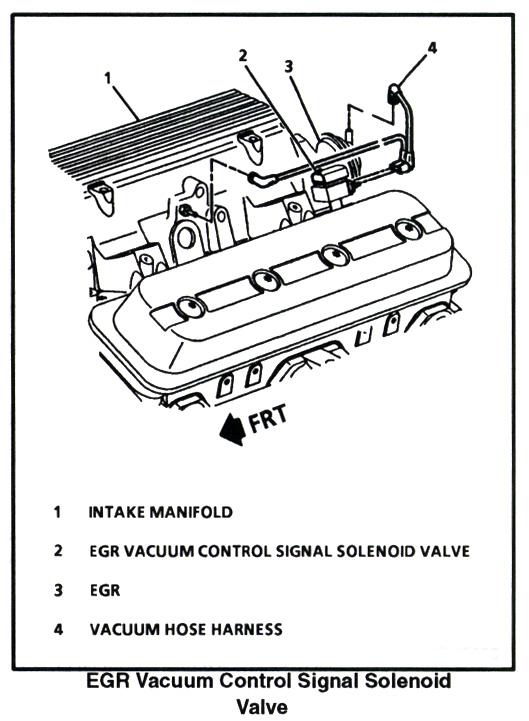
It looks like vacuum comes off the manifold (middle of the intake) and then goes to the solenoid. I see the line leading from the connection block back to the EGR valve, but how does it become engaged and where do I unhook to test? (Step 2). I think I understand step 3.
FYI, Step 1 has confirmed the stumble when I press the valve. It runs fine all other times, even when the SES light comes on.
Finally (maybe) how do I ground the solenoid? According to Shoebox, I jumper pins 5 & 6 on the DLC. Does this mean plug a single wire into both pins to connect them? I should make a tool for this, if so.
It looks like vacuum comes off the manifold (middle of the intake) and then goes to the solenoid. I see the line leading from the connection block back to the EGR valve, but how does it become engaged and where do I unhook to test? (Step 2). I think I understand step 3.
FYI, Step 1 has confirmed the stumble when I press the valve. It runs fine all other times, even when the SES light comes on.
Finally (maybe) how do I ground the solenoid? According to Shoebox, I jumper pins 5 & 6 on the DLC. Does this mean plug a single wire into both pins to connect them? I should make a tool for this, if so.
Last edited by mudbone; Oct 24, 2010 at 06:37 PM.

Registered User
Joined: Dec 1969
Posts: 27,728
From: Little Rock, AR
As always, you are a wealth of LT1 knowledge. In the drawing below, I am having trouble understanding how the vacuum circuit works.
It looks like vacuum comes off the manifold (middle of the intake) and then goes to the solenoid. I see the line leading from the connection block back to the EGR valve, but how does it become engaged and where do I unhook to test? (Step 2). I think I understand step 3.
FYI, Step 1 has confirmed the stumble when I press the valve. It runs fine all other times, even when the SES light comes on.
Finally (maybe) how do I ground the solenoid? According to Shoebox, I jumper pins 5 & 6 on the DLC. Does this mean plug a single wire into both pins to connect them? I should make a tool for this, if so.
It looks like vacuum comes off the manifold (middle of the intake) and then goes to the solenoid. I see the line leading from the connection block back to the EGR valve, but how does it become engaged and where do I unhook to test? (Step 2). I think I understand step 3.
FYI, Step 1 has confirmed the stumble when I press the valve. It runs fine all other times, even when the SES light comes on.
Finally (maybe) how do I ground the solenoid? According to Shoebox, I jumper pins 5 & 6 on the DLC. Does this mean plug a single wire into both pins to connect them? I should make a tool for this, if so.
Thread Starter
Registered User
Joined: Mar 2006
Posts: 676
From: Rixeyville, VA

Guest
Joined: Sep 2004
Posts: 0
You want to be sure the solenoid is changing position. Easiest way is to do as Shoe stated while applying a vacuum or pressure to one side of the solenoid. See if the opposite side then has vacuum or pressure once it changes position. Pressure could be applied with a hose and your mouth.
After that I guess we would have to review what's been tried and see where it takes us. But I think everyone wants to wait until you finish the test at hand.
I did not know putting the PCM into field service mode would cycle the EGR solenoid. I just thought the fans came on.
LSN every day.
After that I guess we would have to review what's been tried and see where it takes us. But I think everyone wants to wait until you finish the test at hand.
I did not know putting the PCM into field service mode would cycle the EGR solenoid. I just thought the fans came on.
LSN every day.
Last edited by Guest47904; Oct 25, 2010 at 08:35 AM.
Thread Starter
Registered User
Joined: Mar 2006
Posts: 676
From: Rixeyville, VA
Mudbone, III broke his arm on Saturday and we've been at the doctor's office all day getting him taken care of. Needless to say, I have not had time to pickup a vacuum pump. I'm going to try to grab one tomorrow. Is it possible for me to get one I can use for both this test and brake bleeding?
I appreciate all the help. I'll report in as soon as I've run through these test.
I appreciate all the help. I'll report in as soon as I've run through these test.
Thread Starter
Registered User
Joined: Mar 2006
Posts: 676
From: Rixeyville, VA
OK, I couldn't wait.
Fred. I got off my butt and looked at the car. I now understand how the circuit works. What I thought was a hose in the diagram were leader-lines. I get it.
I figured that since the hoses look like new (yea, they really do) and I wasn't hearing any leakage, I'd move to step 3. I hooked up a paper-clip jumper and started the car. The SES light flashed on and off the whole time the DLC was jumpered (5-to-6). There was no stumble, like when I manually pressed the valve diaphragm. FWIW, I didn't hear the fans come on either.
So, if I did this right -- and there's no assurance of that -- I have a bad solenoid or a plugged vacuum line.
I guess I'm lacking confidence here since the fans didn't come on when I forced the filed service mode. Am I missing something else, before I go buy a vacuum pump?
Fred. I got off my butt and looked at the car. I now understand how the circuit works. What I thought was a hose in the diagram were leader-lines. I get it.
I figured that since the hoses look like new (yea, they really do) and I wasn't hearing any leakage, I'd move to step 3. I hooked up a paper-clip jumper and started the car. The SES light flashed on and off the whole time the DLC was jumpered (5-to-6). There was no stumble, like when I manually pressed the valve diaphragm. FWIW, I didn't hear the fans come on either.
So, if I did this right -- and there's no assurance of that -- I have a bad solenoid or a plugged vacuum line.
I guess I'm lacking confidence here since the fans didn't come on when I forced the filed service mode. Am I missing something else, before I go buy a vacuum pump?
Registered User
Joined: Dec 1969
Posts: 27,728
From: Little Rock, AR
I don't believe the testing info is meant to have you run the engine. It is just to operate the solenoid, so you can use your vacuum pump and such to test the vacuum circuits. You just turn the key to ON. I just re-read the instructions on my site. It says "don't start".
Thread Starter
Registered User
Joined: Mar 2006
Posts: 676
From: Rixeyville, VA
I don't believe the testing info is meant to have you run the engine. It is just to operate the solenoid, so you can use your vacuum pump and such to test the vacuum circuits. You just turn the key to ON. I just re-read the instructions on my site. It says "don't start".
Thread Starter
Registered User
Joined: Mar 2006
Posts: 676
From: Rixeyville, VA
Guest
Joined: Sep 2004
Posts: 0
No I was not referring to using a jumper. I just wanted to know if the fans ever worked.
Clearly, Shoe was referring to NOT running the engine while you have it in service mode.
You don't need to buy anything. If you are only checking to see if an orifice is open or closed. You only need a hose and your mouth. Yes the mite e vac can be used for other things like bleeding brakes, but to merely check the operation of a solenoid that allows air to flow through it, not necessary.
Clearly, Shoe was referring to NOT running the engine while you have it in service mode.
You don't need to buy anything. If you are only checking to see if an orifice is open or closed. You only need a hose and your mouth. Yes the mite e vac can be used for other things like bleeding brakes, but to merely check the operation of a solenoid that allows air to flow through it, not necessary.