


Rod diffences?



Registered User
Joined: Oct 2004
Posts: 690
From: St. Charles, IL
The "I" beam connecting rod is typically the sytle that is found in a factory motor and although there are certainly good quality I beam style connecting rods available thru both the vehicle manufacturer and the aftermarket, most would agree the there is some additional strength and reliability to be gained with a quality H beam style rod. Additional costs and maybe some clearence issues would be the downside to upgrading to an H beam style rod. I buy into the philosophy that you should build the most durable motor you can afford as you are never really ever happy with the performance of the motor and will continue to throw more at it as time goes by, especially once you get bit by the forced induction bug.

Moderator
Joined: Dec 1969
Posts: 10,745
From: Buffalo, New York
The above post implies consensus on this, but there is none. What most people consider the "best" non-billet steel rod is the Oliver, which is an I beam. Most Ti rods are H-beam, but some are I-beam and others are a hybrid of the two shapes: 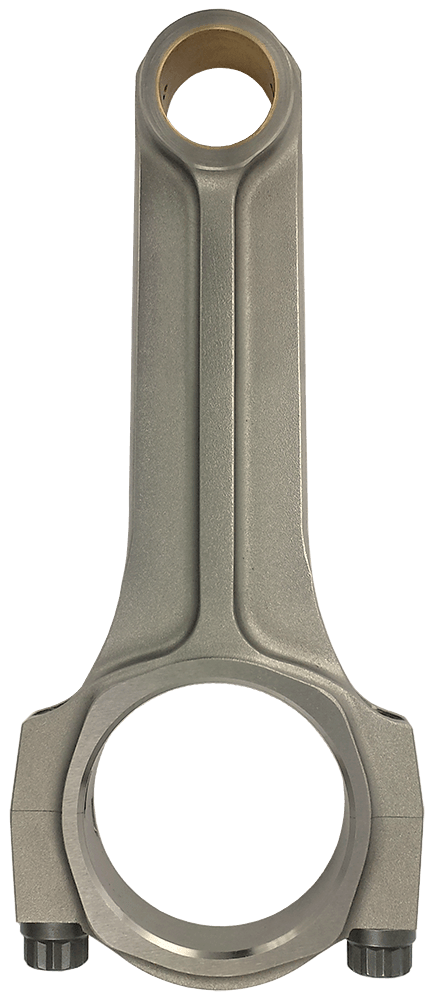 Aluminum rods have a contuor more sugestive of the "I" shape, but are really more of a block of aluminum than anything else: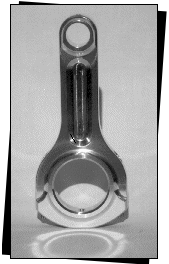
I personally have no preference based on I vs. H-beam. I have, and do, use both. I have a set of H-beams in my race car and I-beams in the Camaro currently. I would not choose a rod on that basis. I-beams are often easier to clearance the big end in a stroker application.
Rich
Aluminum rods have a contuor more sugestive of the "I" shape, but are really more of a block of aluminum than anything else: I personally have no preference based on I vs. H-beam. I have, and do, use both. I have a set of H-beams in my race car and I-beams in the Camaro currently. I would not choose a rod on that basis. I-beams are often easier to clearance the big end in a stroker application.
Rich
Last edited by rskrause; Jan 18, 2007 at 08:54 AM.
Moderator
Joined: Dec 1969
Posts: 10,745
From: Buffalo, New York
One other thing: primary rod failures are VERY rare in all but extreme applications (very high boost, big nitrous). High rpm, especially with a heavy pistons can cause big end distortion and rod bearing failure. But that has nothing to do with an I vs. H-beam profile.
Rich
Rich

Moderator
Joined: Dec 1969
Posts: 10,745
From: Buffalo, New York
The 8-8,500 range and above, especially if the high rpm is prolonged. That's where you need to think hard about weight at the small end and a very strong rod. In terms of the I v. H-beam discussion, "strength" has nothing to do with the beam, in this context. You aren't going to stretch or pull apart the beam of any good rod. It's the strength of the big end and the rod bolts. Also, if relatively high rpm is used for VERY long periods, like offshore racing, the issue becomes important at a lower engine speed. Or, where reliability is absolutely critical (aircraft).
The L19 bolts that people buy for those ubiquitous Eagle rods are completely irrelevant for most applications. They are a superior bolt, for sure. But the added strength and clamping force on the big end simply isn't needed for anything but the kind of situation described above. To me, if you need those bolts you also need a better rod!
A production quality 3/8" rod bolt might be torqued to 45-50 ft-lbs and have a clamping force in the 12,000lb range. Upgrade to a 220,000psi bolt and the preload goes up to maybe 13,000lbs with ~65 ft-lbs. Not a huge difference except in the kind of situation described above. BTW: that's why 7/16" rod bolts are needed for highly stressed big ends. A top quality 7/16" rod bolt is torqued to ~80 ft-lbs. and has ~18,000lbs of preload
Rich.
The L19 bolts that people buy for those ubiquitous Eagle rods are completely irrelevant for most applications. They are a superior bolt, for sure. But the added strength and clamping force on the big end simply isn't needed for anything but the kind of situation described above. To me, if you need those bolts you also need a better rod!
A production quality 3/8" rod bolt might be torqued to 45-50 ft-lbs and have a clamping force in the 12,000lb range. Upgrade to a 220,000psi bolt and the preload goes up to maybe 13,000lbs with ~65 ft-lbs. Not a huge difference except in the kind of situation described above. BTW: that's why 7/16" rod bolts are needed for highly stressed big ends. A top quality 7/16" rod bolt is torqued to ~80 ft-lbs. and has ~18,000lbs of preload
Rich.

Thread
Thread Starter
Forum
Replies
Last Post