


Door speakers and rear speakers


Registered User
Joined: Aug 2006
Posts: 121
From: St. Pete, FL
In short, when your input voltage is too much and becomes leveled off, causing DC rather than AC voltage to go to the speaker.
I'm sure there is a image of a o-scope showing the leveled off signal somewhere, that would be a perfect example.
I'm sure there is a image of a o-scope showing the leveled off signal somewhere, that would be a perfect example.
Last edited by the727kid; Nov 28, 2006 at 06:24 PM.

Registered User
Joined: Aug 2001
Posts: 305
From: Central NJ USA
Ever seen a Bose demo kiosk next to other speakers? No? Guess why that is.
Kevin
Registered User
Joined: Aug 2001
Posts: 305
From: Central NJ USA
You want to get speakers that have an RMS value range that matches the output of the system. For instance...A head unit has 50W X 4 max output and a 15W - 20W RMS rating. The speakers you want should have an RMS value of under 15W to above 20W and a max power rating of above 50W.
This should be an easy read. Most of the info is universal.
Kevin

Registered User
Joined: Nov 2000
Posts: 1,858
From: OHIO Go Buckeyes!
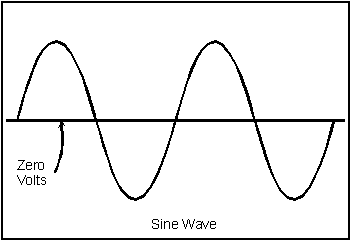
with plus and minus 20volt peaks it produces an almost square wave with flattened out peaks (like this)
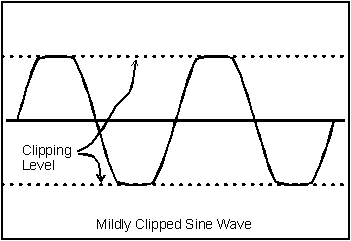
at plus and minus 15volts. The flattened out portion of the sign al is DC voltage. This is the portion of the signal that can damage the voice coil of a speaker. When a speaker is reproducing sound it partially relies on the in and out motion of the cone to help cool the voice coil. When the DC portion of the signal arrives at the voice coil that motion stops for an instant before it continuse to reproduce the rest of the signal. Then it reaches the other flattened out portion of the signal and the cone's motion stops again. During these DC voltage portions of the signal there is no motion and the voice coil begins to heat up. If enough heat builds up it will eventually cause the voice coil to fail by melting the laminate around the voice coil wires causing them to short out. Another possibility is the glue that holds the voice coil to the speaker cone breaks down from the heat and the voice coil detaches from the cone.
Tweeters with passive crossovers don't have this problem but they are still susceptible to damage from clipping. The series capacitor that blocks the lows from going to a tweeter also blocks DC voltage from getting to the tweeter. In this case the tweeter would see a signal similar to the clipped wave above but instead of having the flat portions it would look more like an upper case "M". When the DC portion of the clipped signal arrives at the capacitor it blocks that voltage and the tweeter dome begins to fall back to zero voltage until the clipped portion of the wave passes by. At that point the tweeter dome shoots back up again to it's peak (the second point in the letter M) and then begins to fall back to zero volts before it goes on to reproduce the negative portion of the signal at which point the whole thing starts all over again. These peaks in the letter M portion of the signal contain high energy levels that can be responsible for the tweeter failing. Now if you are using an active crossover there will be no series capacitor with the tweeter which means it will then receive the DC voltage portion of the signal just like a woofer would. This will of course also blow the tweeter.
Registered User
Joined: Aug 2006
Posts: 121
From: St. Pete, FL
"The flattened out portion of the sign al is DC voltage."
"Clipping is what happens when an amplifier is asked to swing more output voltage than it's power supply rails can deliver."
Is this not what I said except in one sentence? The voltage is too great thus causing clipping. I didn't go into a 5 paragraph essay but you said any anwser will do. .
.
"Clipping is what happens when an amplifier is asked to swing more output voltage than it's power supply rails can deliver."
Is this not what I said except in one sentence? The voltage is too great thus causing clipping. I didn't go into a 5 paragraph essay but you said any anwser will do.
.
Registered User
Joined: Nov 2000
Posts: 1,858
From: OHIO Go Buckeyes!
Yeah, I figured you'd say something like that. I don't interpret anything you said to even be remotely close to what I said.
Wrong again. The voltage on the amp's power rails is at a fixed level. When you try to force the amp to deliver more voltage than it can swing you get clipping.
Wrong again. The voltage on the amp's power rails is at a fixed level. When you try to force the amp to deliver more voltage than it can swing you get clipping.

Registered User
Joined: Aug 2006
Posts: 922
did you read that on Wikipedia?
http://en.wikipedia.org/wiki/Clipping_(audio)
Originally Posted by wikipedia
When an amplifier is pushed to create a signal with more power than it can support, it will amplify the signal only up to its maximum capacity, at which point the signal will be amplified no further. As the signal simply "cuts" or "clips" at the maximum capacity of the amplifier, the signal is said to be "clipping." The extra signal which is beyond the capability of the amplifier is simply cut off, resulting in a distorted waveform.
Registered User
Joined: Aug 2006
Posts: 121
From: St. Pete, FL
Yeah, I figured you'd say something like that. I don't interpret anything you said to even be remotely close to what I said.
Wrong again. The voltage on the amp's power rails is at a fixed level. When you try to force the amp to deliver more voltage than it can swing you get clipping.
Wrong again. The voltage on the amp's power rails is at a fixed level. When you try to force the amp to deliver more voltage than it can swing you get clipping.
 Is this what I just said. More voltage = clipping?
 Eh, I'm done with this subject. I can't really argue with someone 30 years into it, that's almost twice as long as I been alive.

Thread
Thread Starter
Forum
Replies
Last Post
Anderson
Car Audio and Electronics
2
Jul 28, 2002 10:57 AM

