


Video: Springless engine


Thread Starter
Registered User
Joined: Mar 2005
Posts: 3,123
From: Melbourne, Australia

Thread Starter
Registered User
Joined: Mar 2005
Posts: 3,123
From: Melbourne, Australia
Actually, this technology is nothing new (I found out after I posted) as Ducati use the Desmodromic valve system on their motorcycles today. In 1955, Mercedes used the technology on some of their racecars.
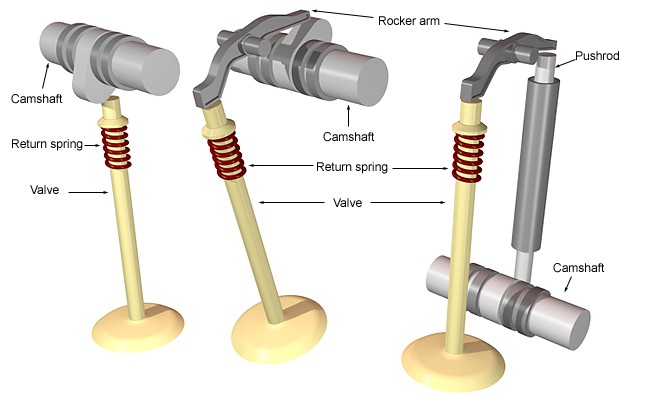
It looks cool anyway, even if it doesn't quite overcome the capabilities of modern valve springs.
It looks cool anyway, even if it doesn't quite overcome the capabilities of modern valve springs.
Last edited by SSbaby; Feb 2, 2010 at 06:39 AM.


Registered User
Joined: Jun 2000
Posts: 3,463
From: SoCal
People into motorcycles know of this system because as you mentioned Ducati has utilized it for a long time.
I've often wondered why more automotive or even other motorcycle manufacturers have not designed their version of the spring less valve system. I would guess if the gains were that much better they would have.
I've often wondered why more automotive or even other motorcycle manufacturers have not designed their version of the spring less valve system. I would guess if the gains were that much better they would have.

Registered User
Joined: Jun 2004
Posts: 2,977
From: SeVa
Desmodromic was the first thing that popped into my mind when I oped the OHV vid.
Seems to me somebody some while back made mention of a conventional valvetrain really not being that bad in terms effciency, but I can't remember the stated reason?????
Seems to me somebody some while back made mention of a conventional valvetrain really not being that bad in terms effciency, but I can't remember the stated reason?????
Last edited by bossco; Feb 3, 2010 at 10:37 PM.


Registered User
Joined: Oct 2005
Posts: 940
From: Southern Indiana
Thread Starter
Registered User
Joined: Mar 2005
Posts: 3,123
From: Melbourne, Australia
The camless engine needs 42V electrical power to work properly but there are cost and longevity issues to overcome.
Pros and Cons
What are the pros and cons? First, there is no technical challenge posed by 42V systems that cannot be solved. The real issue is cost, particularly as it compares to the current 14V system.
<>For example, 42V system batteries capable of offering comparable life with current 12V batteries require more costly technologies, such as lithium or nickel-metal hydride, to implement. Arcing and corrosion issues can be addressed through the addition of battery disconnect switches and sealed connectors at an added cost.
Suppliers will continue to improve technology to reduce the cost of solving the technical challenges. At the same time, the applications for electronic and electrical systems will continue to grow. As the relative cost of 42V systems decreases and the electrical content grows, the rate of 42V system adoption will gain momentum.
Supplier challenge
For suppliers of electrical and electronic components, what does the current situation entail?
Companies must continue to both optimize the capabilities of 14V systems and address the challenges of 42V systems. This must be done on realistic R&D budgets that reflect the economics of our times.
Thus, a coordinated effort in technology and product development must be made to ensure the most effective use of limited resources.
http://www.automotivedesignline.com/howto/199201615
What are the pros and cons? First, there is no technical challenge posed by 42V systems that cannot be solved. The real issue is cost, particularly as it compares to the current 14V system.
<>For example, 42V system batteries capable of offering comparable life with current 12V batteries require more costly technologies, such as lithium or nickel-metal hydride, to implement. Arcing and corrosion issues can be addressed through the addition of battery disconnect switches and sealed connectors at an added cost.
Suppliers will continue to improve technology to reduce the cost of solving the technical challenges. At the same time, the applications for electronic and electrical systems will continue to grow. As the relative cost of 42V systems decreases and the electrical content grows, the rate of 42V system adoption will gain momentum.
Supplier challenge
For suppliers of electrical and electronic components, what does the current situation entail?
Companies must continue to both optimize the capabilities of 14V systems and address the challenges of 42V systems. This must be done on realistic R&D budgets that reflect the economics of our times.
Thus, a coordinated effort in technology and product development must be made to ensure the most effective use of limited resources.
http://www.automotivedesignline.com/howto/199201615

Registered User
Joined: Aug 1998
Posts: 511
From: Mill Creek, WA
I like the idea of improving OHV engine technology but is more horsepower worth reduced reliability?
What I see from that setup is many more parts = many more possibilities for failures. The beauty in the OHV engine IMO is it's simplicity yet outstanding performance.
What I see from that setup is many more parts = many more possibilities for failures. The beauty in the OHV engine IMO is it's simplicity yet outstanding performance.


Thread
Thread Starter
Forum
Replies
Last Post
JasonD
Midwest
14
Aug 23, 2010 03:14 PM
Caps94ZODG
Automotive News / Industry / Future Vehicle Discussion
22
Jul 30, 2002 08:45 AM