

View Poll Results: Do oil/energy companies "fix" or manipulate pricing?
Yes - unquestionably.


39
73.58%
Maybe a little.


10
18.87%
No - not at all.


4
7.55%
Voters: 53. You may not vote on this poll
Price-Fixing of Fuels - Does it happen or not?


Registered User
Joined: Feb 2005
Posts: 888
From: La Porte City, Iowa

You do realize that there were a few stations that were FORCED to close this last year because they priced their gas to low. Explain that away. Owned by some older guy that was fed up with the high prices, so he set his about 30 cents lower than everyone else.

Registered User
Joined: Nov 1998
Posts: 3,252
From: Knoxville, TN
hehehehehe. Have a great day, Threxx. You're safe here. 
And now, back to the subject at hand...in public...lacking intelligence or not....
I neither said, nor implied (at least not intentionally) either of your those. I simply stated that what a single gas station does cannot, and should not be construed to be the wishes, or act, of a "big oil" company - at least not automatically, or without some sort of evidence to show otherwise.
And what about the opposite that I posted? What happens when the guy across the street LOWERS his/her price?
Don't have to - nor do I know the whole story. Do you? Do you have this "older guys" side of it, and the companies side of it so that we can compare the two and come to an indepedent opinion?
Related....recently here in Va Beach, there was a "gas war" of sorts between a brand new gas station and one that had been there for many years. The location is at the corner of Salem Road & Elbow Road. One is a 7-11, don't remember the other. Anyway, one at a time, they dropped the price of regular down to ~$1.99. Stayed that way for a short while, though they have now come back up to nearer normal (perhaps a couple of pennies cheaper than most). They didn't get shut down. In fact, I'd suggest the distributor loved it....he made his profit at his price, and probably could care less if the gas station didn't - that station was selling a LOT of his gas at his price.
Here's a link to the beginning of it (all I could find): http://www.wtkr.com/Global/story.asp?s=7624411
And now, back to the subject at hand...in public...lacking intelligence or not....
And what about the opposite that I posted? What happens when the guy across the street LOWERS his/her price?
You do realize that there were a few stations that were FORCED to close this last year because they priced their gas to low. Explain that away. Owned by some older guy that was fed up with the high prices, so he set his about 30 cents lower than everyone else.[/
Related....recently here in Va Beach, there was a "gas war" of sorts between a brand new gas station and one that had been there for many years. The location is at the corner of Salem Road & Elbow Road. One is a 7-11, don't remember the other. Anyway, one at a time, they dropped the price of regular down to ~$1.99. Stayed that way for a short while, though they have now come back up to nearer normal (perhaps a couple of pennies cheaper than most). They didn't get shut down. In fact, I'd suggest the distributor loved it....he made his profit at his price, and probably could care less if the gas station didn't - that station was selling a LOT of his gas at his price.
Here's a link to the beginning of it (all I could find): http://www.wtkr.com/Global/story.asp?s=7624411

Registered User
Joined: Mar 2005
Posts: 3,123
From: Melbourne, Australia
China's oil consumption increased by ~45% between 2000 and 2005. As of this past June, they were the 2nd biggest consumer (the US is first, of course).
India's oil consumption increased by ~10% between 2000 and 2005. As of this past June, they were the 6th biggest consumer (Japan, Germany, & Russia were ahead).
I'd say that is fairly major.
India's oil consumption increased by ~10% between 2000 and 2005. As of this past June, they were the 6th biggest consumer (Japan, Germany, & Russia were ahead).
I'd say that is fairly major.
The other 'unknown' is whether there is a significant turnover of vehicles in China (i.e. new vehicles replacing older). This would have less impact on increased demand as the demand was there initially.
And India's market is fickle at best. I still don't think India's demand is significant.
Food for thought?
Registered User
Joined: Nov 1998
Posts: 3,252
From: Knoxville, TN
All that data (including the decades prior to 2000) is in the link I posted: http://www.swivel.com/data_sets/spreadsheet/1003357
I cannot correlate chinese auto sales to oil consumption. Perhaps someone else can. I can only tell you raw numbers. For example...
2001-2002 consumption increased by ~8%
2002-2003 consumption increased by ~10%
2003-2004 consumption increaesd by ~17%
2004-2005 consumption increaesd by ~4%
I guess I should go look for 2006+ numbers (assuming they're available), but I'm too lazy.
India...don't know what qualifies as "fickle", but excepting 2004-2005, their consumption was increasing at a fairly steady over over the last couple of decades. (Note: USA consumption decreased slightly from 2004 to 2005 too).
Interesting Note: China didn't move ahead of Japan till 2003 (Japanese consumption shows a slight drop over the past decade).
Also...world oil consumption has steadily increased since the end of WWII. I would suggest that you get to a point where the amount of excess supply isn't sufficient to keep prices stable. And given that it is very much a WORLD market, where anything from GOMEX Hurricanes to severe North Sea storms to bully-talk by Hugo Chavez to Iran firing a couple of missiles into the Strait of Hormuz can have a significant effect on day-to-day prices, the trading of this commodity is BOUND to have fairly violent fluctuations - no matter what Exxon-Mobil, or Chevron, or BP, or any other large corporation wants.
Finally...that is NOT to say that they don't have any influence at all on prices. They do - they have to. I simply don't buy in to the "evil oil company" arguements...and certainly not into the "gov't regulation can fix it" idea.
Here's some more interesting facts (and I take them as such, though I cannot verify independently): http://www.gravmag.com/oilessay.html
No opinions in there...just interesting stuff. Now, this can be called "opinion", though I think of it as analysis: http://www.aapg.org/explorer/2003/04...ion_answer.cfm
Another one...but to be fair, I must add that this is written by the oil industry: http://www.capp.ca/default.asp?V_DOC_ID=1150
And finally, some thoughtful opinion: http://www.gravmag.com/oil3.html
Bob
I cannot correlate chinese auto sales to oil consumption. Perhaps someone else can. I can only tell you raw numbers. For example...
2001-2002 consumption increased by ~8%
2002-2003 consumption increased by ~10%
2003-2004 consumption increaesd by ~17%
2004-2005 consumption increaesd by ~4%
I guess I should go look for 2006+ numbers (assuming they're available), but I'm too lazy.
India...don't know what qualifies as "fickle", but excepting 2004-2005, their consumption was increasing at a fairly steady over over the last couple of decades. (Note: USA consumption decreased slightly from 2004 to 2005 too).
Interesting Note: China didn't move ahead of Japan till 2003 (Japanese consumption shows a slight drop over the past decade).
Also...world oil consumption has steadily increased since the end of WWII. I would suggest that you get to a point where the amount of excess supply isn't sufficient to keep prices stable. And given that it is very much a WORLD market, where anything from GOMEX Hurricanes to severe North Sea storms to bully-talk by Hugo Chavez to Iran firing a couple of missiles into the Strait of Hormuz can have a significant effect on day-to-day prices, the trading of this commodity is BOUND to have fairly violent fluctuations - no matter what Exxon-Mobil, or Chevron, or BP, or any other large corporation wants.
Finally...that is NOT to say that they don't have any influence at all on prices. They do - they have to. I simply don't buy in to the "evil oil company" arguements...and certainly not into the "gov't regulation can fix it" idea.
Here's some more interesting facts (and I take them as such, though I cannot verify independently): http://www.gravmag.com/oilessay.html
No opinions in there...just interesting stuff. Now, this can be called "opinion", though I think of it as analysis: http://www.aapg.org/explorer/2003/04...ion_answer.cfm
Another one...but to be fair, I must add that this is written by the oil industry: http://www.capp.ca/default.asp?V_DOC_ID=1150
And finally, some thoughtful opinion: http://www.gravmag.com/oil3.html
Bob
Last edited by Bob Cosby; Feb 9, 2008 at 04:51 PM.
Registered User
Joined: Mar 2005
Posts: 3,123
From: Melbourne, Australia
Bob
Good information and resource material.
Given the steady increase in demand/supply as explained on the spreadsheet, I'm still at a loss to explain the sharp increase in the price of crude, in the last 2 years alone (~50%)? This period coincides with the fall in the $USD, the currency in which crude oil prices are priced. Theoretically, this should mean cheaper fuel for every nation outside of the US but 'we' are having paying substantially more. I'm keen to understand why?
Good information and resource material.
Given the steady increase in demand/supply as explained on the spreadsheet, I'm still at a loss to explain the sharp increase in the price of crude, in the last 2 years alone (~50%)? This period coincides with the fall in the $USD, the currency in which crude oil prices are priced. Theoretically, this should mean cheaper fuel for every nation outside of the US but 'we' are having paying substantially more. I'm keen to understand why?

Registered User
Joined: Aug 2001
Posts: 2,400
From: Michigan's left coast
Bob, it's the timing that I'm more concerned about. No good choosing the period from 2000-2005. The 'explosion' in auto sales inChina began in 2002/2003. So why did this have relatively little impact on oil prices back then? I know China is selling a lot more autos now than they were back in 2000, but I'm interested why it's become a major problem now when there was barely a ripple in 2002/2003?

Interpret that as you will.
And India's market is fickle at best. I still don't think India's demand is significant.
http://www.indexmundi.com/india/oil_consumption.html
Opinions will vary on whether this is significant. Frankly, it's a matter of supply - if there's another 2.5M barrels/day of "easy" oil, this is no big deal; if we're near peak capacity, then it's a huge deal.
Registered User
Joined: Mar 2005
Posts: 3,123
From: Melbourne, Australia
My wrong. The spreadsheet is about oil consumption only (not demand/supply).
Yes, there does seem to be a consistent gradient in the curve since 2000.
If that gradient continues, one would expect the same increase in oil price over the next couple of years as the past couple.
Yes, there does seem to be a consistent gradient in the curve since 2000.
If that gradient continues, one would expect the same increase in oil price over the next couple of years as the past couple.

Registered User
Joined: Feb 1999
Posts: 2,947
From: Springfield,OH. U.S.A.
Originally Posted by Bob Cosby
90rocz....I'd like to see the evidence of commodities being deregulated and then prices soaring.
90rocz....I'd like to see the evidence of commodities being deregulated and then prices soaring.
http://www.usatoday.com/money/indust...ctricity_N.htm
Some more info aluding to more areas deregulation has hurt us, which anyone can search for themselves and investigate.
http://www.commondreams.org/views01/0831-03.htm
"Cable rates have risen 33 percent, three times the inflation rate, since the 1996 telecom-dereg debacle."
"Ditto local phone competition. Prices are up 12 percent,"
"The gradual development of near-monopolies -- only the biggest survive -- is also a familiar pattern in these cases. Airlines have dropped service at small communities and routinely over-schedule at major airports. The system drifts into worse shape annually, with no end in sight, and Congress has done nothing because God forbid anyone should interfere with the free market."
"Ditto local phone competition. Prices are up 12 percent,"
"The gradual development of near-monopolies -- only the biggest survive -- is also a familiar pattern in these cases. Airlines have dropped service at small communities and routinely over-schedule at major airports. The system drifts into worse shape annually, with no end in sight, and Congress has done nothing because God forbid anyone should interfere with the free market."
Last edited by 90rocz; Feb 10, 2008 at 01:59 AM.

Registered User
Joined: Nov 1998
Posts: 3,252
From: Knoxville, TN
Tks for the links. Some comments....
My first thought on this....the arguement above was that the electric industry WAS regulated, and because of its success, oil should follow suit? Second, the article itself stated that "But competition, especially for residential and small business customers, rarely emerged." I'd suggest this is key. And third, is electricity considered a "commodity"?
Additionally, the article states that "Exelon executive vice president Betsy Moler said rates in all states, regardless of their regulatory structure, have soared about 34% since 1996, mirroring fuel cost increases."
I think the rates for fuel have increased far, far more than 34%.
Regardless...I will agree wholeheartedly that deregulation of our Electricity infrastructure will only prove useful if there is competition. And right now, by and large, there isn't.
Finally, I'll still suggest you can't compare the electric industry to the oil industry.
Oh my. Commondreams.org is a self-described "Progressive Community". The term "progressive" is the PC description of "Liberal", and they essentially envision a Socialist Democracy for our country. I would suggest at least pointing this out when using their site as evidence to make an arguement (I did the same when I posted a link above).
Anyway, that link is 7 years old. The article uses data from 96 to 01. What has happened since then? Finally, this article offers much opinion (far left opinion), but precious few facts or figures (and those that it does provide, are dated).
SSbaby....It is hard to imagine anything other than a continued increase in the price of oil until and unless demand starts to decrease. That is going to take a while.
Bob
Bob, here's one article on a quick search about deregulation:
http://www.usatoday.com/money/indust...ctricity_N.htm
http://www.usatoday.com/money/indust...ctricity_N.htm
Additionally, the article states that "Exelon executive vice president Betsy Moler said rates in all states, regardless of their regulatory structure, have soared about 34% since 1996, mirroring fuel cost increases."
I think the rates for fuel have increased far, far more than 34%.
Regardless...I will agree wholeheartedly that deregulation of our Electricity infrastructure will only prove useful if there is competition. And right now, by and large, there isn't.
Finally, I'll still suggest you can't compare the electric industry to the oil industry.
Some more info aluding to more areas deregulation has hurt us, which anyone can search for themselves and investigate.
http://www.commondreams.org/views01/0831-03.htm
http://www.commondreams.org/views01/0831-03.htm
Anyway, that link is 7 years old. The article uses data from 96 to 01. What has happened since then? Finally, this article offers much opinion (far left opinion), but precious few facts or figures (and those that it does provide, are dated).
SSbaby....It is hard to imagine anything other than a continued increase in the price of oil until and unless demand starts to decrease. That is going to take a while.
Bob

Registered User
Joined: Feb 1999
Posts: 2,887
From: northeast Miss.

Registered User
Joined: Jan 2000
Posts: 10,285
From: Albany, NY
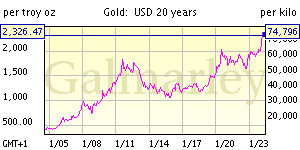
Some of you might find this site interesting as well since you guys are looking at the precious metal to oil correlation. http://thomaspainesblog.blogspot.com...dollars-8.html
Comparison Prices for Various Markets on 8. Feb. 2008
Ag$ - FR$
Silver, per ounce Troy - 1.29 17.18
Gold, per ounce Troy - 69.48 923.20
Platinum, per ounce Troy - 141.56 1,881.00
Palladium, per ounce Troy - 32.89 437.00
Gasoline, Regular, per gallon - 0.222 2.955
Crude Oil, per barrel - 6.90 91.71
DJIA - 916.80 12,182.10
Ag$ = Standard Silver Dollars (371.25 grains of pure silver)
FR$ = Federal Reserve Dollars
Ag$ - FR$
Silver, per ounce Troy - 1.29 17.18
Gold, per ounce Troy - 69.48 923.20
Platinum, per ounce Troy - 141.56 1,881.00
Palladium, per ounce Troy - 32.89 437.00
Gasoline, Regular, per gallon - 0.222 2.955
Crude Oil, per barrel - 6.90 91.71
DJIA - 916.80 12,182.10
Ag$ = Standard Silver Dollars (371.25 grains of pure silver)
FR$ = Federal Reserve Dollars
Last edited by Z28x; Feb 10, 2008 at 09:39 PM.

Registered User
Joined: Apr 2003
Posts: 547
It's not necesarily the Oil Companies that are price fixing, it is the people who they buy the crude from. Most of their crude comes from their equipment stationed on someone elses land, and therefore the crude belongs to who owns the land.
They (those who own the land) decide how much to charge for what they are selling. They get together as a group and come to a decision. That's price fixing. They determine some regions get fuel at higher or lower prices, that's price fixing.
It's not illegal because it is done outside of the US.
Look at Venezuela. They own the land and the refineries. They sell a good part of their product to the US, but the rest they give away to their own people, how can they do this? Because their equipment is all paid for.... It is old and needs repair or replacing, but they give free gas instead of selling it and fixing it.
They (those who own the land) decide how much to charge for what they are selling. They get together as a group and come to a decision. That's price fixing. They determine some regions get fuel at higher or lower prices, that's price fixing.
It's not illegal because it is done outside of the US.
Look at Venezuela. They own the land and the refineries. They sell a good part of their product to the US, but the rest they give away to their own people, how can they do this? Because their equipment is all paid for.... It is old and needs repair or replacing, but they give free gas instead of selling it and fixing it.
Last edited by 5thGen; Feb 10, 2008 at 09:43 PM.
Registered User
Joined: Mar 2005
Posts: 3,123
From: Melbourne, Australia
One question that I always wanted to ask but was waiting until 5thGen touched on it...
Who controls Iraq's oil fields now that Saddam is no longer in control of the country? I'd assume the US govt is in control to some degree?
AND whoever is in control of Iraq's oil fields, is the controller fixing prices there?
Who controls Iraq's oil fields now that Saddam is no longer in control of the country? I'd assume the US govt is in control to some degree?
AND whoever is in control of Iraq's oil fields, is the controller fixing prices there?