


If the front cam bearing is worn = no cam?


Registered User
Joined: Mar 2002
Posts: 3,245
From: Ocala, Florida
Great post.
Here was my front cam bearing at ~70K miles, it was gold and scratched all to pieces:
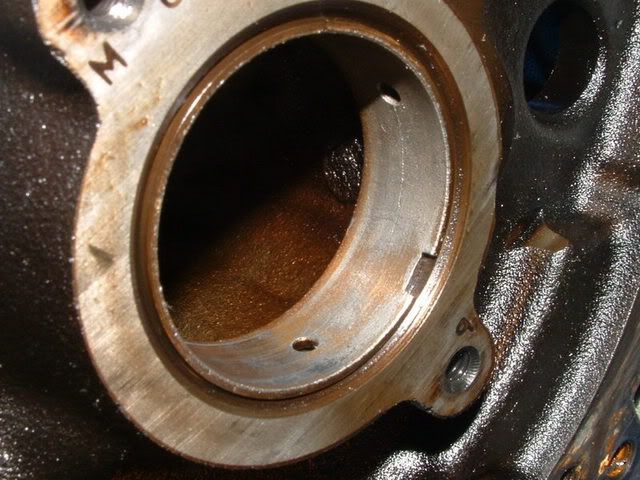
I was was wanting to to do a H&C but did not chance it. I pulled the motor for a full rebuild to the specs in my sig. The stock cammed stock motor ran fine with decent oil pressure. The stock cam had a few scratch marks on the front journal.
Bottom line is its a crap shoot to run a new cam on a worn bearing.
Here was my front cam bearing at ~70K miles, it was gold and scratched all to pieces:
I was was wanting to to do a H&C but did not chance it. I pulled the motor for a full rebuild to the specs in my sig. The stock cammed stock motor ran fine with decent oil pressure. The stock cam had a few scratch marks on the front journal.
Bottom line is its a crap shoot to run a new cam on a worn bearing.

Registered User
Joined: Dec 1969
Posts: 27,729
From: Little Rock, AR

As accessible as the front cam bearing is, a person could replace it, if they wanted to. All cam bearings cannot be replaced with the engine in the car.
Last edited by shoebox; Feb 25, 2008 at 12:09 AM.


Thread Starter
Registered User
Joined: Jun 2005
Posts: 1,834
From: Indiana


Registered User
Joined: Oct 2001
Posts: 2,684
The silver top layer is soft and lets particles imbed. The copper layer is a lot tougher and wont imbed particles, but it helps get the heat out of the bearing. Oil pressure is key - As long as you got good oil pressure, you might be OK, but that wear came from metal to metal contact on startup probably, and it will only get worse. You put a new cam in there and maybe scratch it up a little more from the sharp edges, then everything gets a little worse.

Moderator
Joined: Dec 1969
Posts: 10,745
From: Buffalo, New York
I hate to sound nit-picky, but I think it is an important distinction: bearing failures are due to a lack of oil supply. Pressure is a marker for flow, but not the same thing. I once read that the load on the oil film is on the order of 10,000psi (for the mains). Obviously, 60 or 70psi of oil pressure is not what is keeping the parts for metal to metal contact (even for the cam) but it is the oil "wedge" created by the movement of the journals relative to each other. There are better diagrams, but this should suffice:

Rich

Registered User
Joined: Oct 2007
Posts: 387
From: dallas tx
i might be stating this wrong but i think that the cam bearing supply gallery is where the oil pressure is read from because its closest to the pump supply. if the oil pressure drops in this gallery it should effect oil pressure to the rest of the engine. my cam bearing looked similar to the picture above and i went ahed with the swap. the oil pressure droped about 5 psi afterwards. it got worse the more i drove it and within 3000 miles had spun two rods and a main.
Registered User
Joined: Dec 1969
Posts: 27,729
From: Little Rock, AR
I hate to sound nit-picky, but I think it is an important distinction: bearing failures are due to a lack of oil supply. Pressure is a marker for flow, but not the same thing. I once read that the load on the oil film is on the order of 10,000psi (for the mains). Obviously, 60 or 70psi of oil pressure is not what is keeping the parts for metal to metal contact (even for the cam) but it is the oil "wedge" created by the movement of the journals relative to each other. There are better diagrams, but this should suffice:
Rich
Rich
 However, if you are not getting the oil to the bearings, there won't be much chance to have an oil wedge. Pressure may not be the ultimate way to judge what you have, but there aren't too many other indicators available to use.
Oh, yeah...I trashed a rod bearing, but my pressure was still ok.
 ...lost that darn wedge...
Last edited by shoebox; Feb 25, 2008 at 07:24 PM.
Registered User
Joined: Oct 2001
Posts: 2,684
i might be stating this wrong but i think that the cam bearing supply gallery is where the oil pressure is read from because its closest to the pump supply. if the oil pressure drops in this gallery it should effect oil pressure to the rest of the engine. my cam bearing looked similar to the picture above and i went ahed with the swap. the oil pressure droped about 5 psi afterwards. it got worse the more i drove it and within 3000 miles had spun two rods and a main.

Thread
Thread Starter
Forum
Replies
Last Post
Brandon Wittmer
General 1967-2002 F-Body Tech
3
Dec 20, 2014 09:51 PM