


Rim screws


Thread Starter
Banned
Joined: Oct 2006
Posts: 4,970
From: Goochland, Va.
Rim screws
Is the only purpose to keep the rim from spinning? I have never run them before but someone told me it was a safetey issue...if the tire spins on the wheel it will break the bead and the tire goes down or could rip the tube.
So I have to descide if I want to use them or not
So I have to descide if I want to use them or not

Registered User
Joined: Sep 1998
Posts: 458
From: Newark, DE.
Yes, it can def be a safety issue with the tube in there as it can rip out the part attached to the valve stem. I run screws on mine to keep the tire from spinning on the rim but I do not run tubes. I run 8 screws per side of each rear wheel. The only issue I ever had were that my ET streets would lose some air after a week or so.
Registered User
Joined: Jan 2005
Posts: 1,388
From: Moore Oklahoma
I may be taking a risk, but I don't want to drill holes in my Alumi-Stars. But, I have the slick and rim marked and they haven't slipped yet with 1.48 60 ft times.
Also, most slicks without tubes will leak-down over a few days.
WD

Also, most slicks without tubes will leak-down over a few days.
WD


Registered User
Joined: Oct 1998
Posts: 535
From: Engelhard, N.C.
I used rim screws for awhile when I was running 27x11.5x15 QTP's, but since I've switched to the Hoosier 30x9 radial I don't run screws or tubes and the tire never leaks even the slightest amount of air, and I run 18psi cold on race day and have high 1.30 to low 1.40 60fts. Really though I don't how you guys get by with running such low air psi. Engineer, you are wadding your tire up badly and are of need of more air in your tire, a slight wrinkle is fine but that is excessive. If you can't hook with more air you may need to address the suspension some. Here is an example, a buddy of mine has a 99 camaro 408LS1 with 28x11.5x15 and was running 11psi in the tires and ran a 6.55 1/8 time, I told him to put 15psi in the tires and try it, he ran 6.37 and said it was alot easier to drive.
Randy
Randy
Thread Starter
Banned
Joined: Oct 2006
Posts: 4,970
From: Goochland, Va.
I was thinking the same thing........thats really bad for the sidewalls. The sidewall will be to worn to hook long before the tread wears out

Registered User
Joined: Jul 2003
Posts: 553
From: Southern California
The 30 x 9" radials sold by M/T, Hoosier, and Goodyear are Stock Eliminator tires. They are designed to run with 18 to 20 psi and are most typically run on 10" wide rims although they will work with 8" or 9" rims. Back to back, they are worth just about a tenth over a bias ply tires of the same height. They will usually respond to a shorter burnout than a bias ply tire. You will see some people over-heat them but the rule of thumb is: the hotter the track, the shorter the burnout. On a decent track, the best results usually come from getting off the throttle as soon as they make smoke. They have a relatively short track life with anything over 75 runs being above average on LT1 Stockers. I've run those tires on Stockers that were consistently in the 10.70 range and I've seen Al Corda and Ryan McClanahan run 9.90s on them. They're a great tire if you are willing to put up with the track life. Almost no one runs rim screws on those tires.
Air leakage usually occurs through the fabric of the sidewall and is especially bad on some brands of tires. There are a number of backyard fixes for this but as a rule, if you have leakers, they will always be leakers. The 14 x 32 x 15" Phoenix bias tires on my Super Stocker will go completely flat within two days sitting in the trailer. I always change them at the end of any event before the car goes back into the trailer.
c
Air leakage usually occurs through the fabric of the sidewall and is especially bad on some brands of tires. There are a number of backyard fixes for this but as a rule, if you have leakers, they will always be leakers. The 14 x 32 x 15" Phoenix bias tires on my Super Stocker will go completely flat within two days sitting in the trailer. I always change them at the end of any event before the car goes back into the trailer.
c


Registered User
Joined: Mar 2007
Posts: 463
From: GENEVA, Ohio
Rim screws always seems to be a debate-able issue when brought up, I don't think there is a situation for either case that proves the other wrong.
Tire mounting tips:
To prevent "a leaker" or at least to slow it down, you should when mounting the tires to use a very liberal amount of dish washing detergent on the bead and mounting surface on the rim. Make sure the rim is ultra clean at the bead as well.
Air up your tires before you put it on the trailer, that will help the tire hold the rim better and hopefully it will prevent the tire from going down after the car is tied down and possible car damage from having a loose car in the trailer (personal experience not much fun opening the trailer door and seeing the car against the side of the trailer)
The little pink dot is the balance dot, line it up with your valve stem and in most cases you'll use less balancing material.
Never use the balancing weight that are affixed to the outer edge of the rim for safety reasons. I witnessed a car in the burnout box doing its high gear burnout and a weight flew off the car bouncing off the wall behind it and hitting a cam-corder in a ladies hand. It smashed the camera to shreads and cut the ladies has severly. Use the adhesive type but used a bead of silicon to attach them in lieu of the adhesive backing, the adhesive backing isn't always quality adhesive and they are prone to come of the rim.
hope this helps
Tire mounting tips:
To prevent "a leaker" or at least to slow it down, you should when mounting the tires to use a very liberal amount of dish washing detergent on the bead and mounting surface on the rim. Make sure the rim is ultra clean at the bead as well.
Air up your tires before you put it on the trailer, that will help the tire hold the rim better and hopefully it will prevent the tire from going down after the car is tied down and possible car damage from having a loose car in the trailer (personal experience not much fun opening the trailer door and seeing the car against the side of the trailer)
The little pink dot is the balance dot, line it up with your valve stem and in most cases you'll use less balancing material.
Never use the balancing weight that are affixed to the outer edge of the rim for safety reasons. I witnessed a car in the burnout box doing its high gear burnout and a weight flew off the car bouncing off the wall behind it and hitting a cam-corder in a ladies hand. It smashed the camera to shreads and cut the ladies has severly. Use the adhesive type but used a bead of silicon to attach them in lieu of the adhesive backing, the adhesive backing isn't always quality adhesive and they are prone to come of the rim.
hope this helps
Last edited by tomcowle; Jan 10, 2008 at 09:11 AM.
Registered User
Joined: Jan 2005
Posts: 1,388
From: Moore Oklahoma
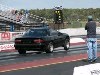
I was also surprised when my friend took that photo above and I saw how much sidewalls wrinkle on the launch. The 60 fts are 1.48 to 1.50, so they are hooking great.
WD
Another launch photo.

Last edited by The Engineer; Jan 10, 2008 at 05:56 PM.

Registered User
Joined: Mar 2000
Posts: 2,037
From: 51°N 114°W, 3500' elevation
Never use the balancing weight that are affixed to the outer edge of the rim for safety reasons.
Hoosiers are probably the best for retaining air. My MT still leak down even after soaping the insides.
If you run tubes, you should be using rim screws. As mentioned above, if the tire slips on the rim, it will rip the valve stem off the tube. I don't run tubes because I use a stiff sidewall tire and don't need the extra support or weight from tubes. I do run 16 rims screws on each side of the rim though. The chances of losing the bead even with low pressure tires is low. I screw the tire to the rim for 2 reasons. If it spins, the balance will change and the amount of rim screws will affect how much wrinkle the sidewall gets. I've experimented from 8 to 15 psi and find 10 works pretty good. That's also with a 32 x 14 tire on a 15 x 15 rim.
Rule of thumb for tire pressure. Run as much as possible until 60' times start to slow down.
Last edited by Stephen 87 IROC; Jan 10, 2008 at 08:26 PM.

Registered User
Joined: Jan 2006
Posts: 230
From: Waterloo, Iowa
In the past, used to just have the tire shop put some bead snot/glue around the bead before inflating and popping it upto the rim, never had a rim rotation issue
Once i started going a little faster and tired of scraping the rims since i change slicks every month i went to screws, no tubes. I tried tubes once and the added weight and difficulty balancing made me throw them out at the end of the month...only nice thing was during the hot summer months with sun blazing down, with the tubes they were much less prone to gaining air pressure than non tubed slicks...which was nice when you are in that weird spot of cars getting pulled out, then a 5-10 minute downtime and then they start pulling again...it's nothing to see a 1-2psi increase on the sunny side of the car after 10-15minutes of sitting idle in the sun in the staging lanes...
Also, bias ply's like to be shocked/hit hard to work, that's the design. I run mine at 10psi for two reason...one it hooks at that psi, but most importantly and the one some guys dont think about...it keeps me GREEN. Any more psi and i redlight by just enough to make you throw stuff/cuss. Same with front tires, if your having issues and your not pulling the tires out of the beam on the hit...start paying attention and checking front tire psi before each run along with your rear tires...very easy to manipulate R/T's with front tires too.
Once i started going a little faster and tired of scraping the rims since i change slicks every month i went to screws, no tubes. I tried tubes once and the added weight and difficulty balancing made me throw them out at the end of the month...only nice thing was during the hot summer months with sun blazing down, with the tubes they were much less prone to gaining air pressure than non tubed slicks...which was nice when you are in that weird spot of cars getting pulled out, then a 5-10 minute downtime and then they start pulling again...it's nothing to see a 1-2psi increase on the sunny side of the car after 10-15minutes of sitting idle in the sun in the staging lanes...
Also, bias ply's like to be shocked/hit hard to work, that's the design. I run mine at 10psi for two reason...one it hooks at that psi, but most importantly and the one some guys dont think about...it keeps me GREEN. Any more psi and i redlight by just enough to make you throw stuff/cuss. Same with front tires, if your having issues and your not pulling the tires out of the beam on the hit...start paying attention and checking front tire psi before each run along with your rear tires...very easy to manipulate R/T's with front tires too.
Registered User
Joined: Jan 2001
Posts: 838
From: ajax ontario canada
I only have 12 passes on my car since I just finished it in september and only got the car out really the 1 time.Mine are just the little baby 26 inch tires but from what paople tell me I should use 16 as a starting point.right now it dead hooks and lifts the fronts fairly good of the t-brake
Registered User
Joined: Jan 2005
Posts: 1,388
From: Moore Oklahoma
Like I said I cant wait to get back and try more air.
I only have 12 passes on my car since I just finished it in september and only got the car out really the 1 time.Mine are just the little baby 26 inch tires but from what paople tell me I should use 16 as a starting point.right now it dead hooks and lifts the fronts fairly good of the t-brake
I only have 12 passes on my car since I just finished it in september and only got the car out really the 1 time.Mine are just the little baby 26 inch tires but from what paople tell me I should use 16 as a starting point.right now it dead hooks and lifts the fronts fairly good of the t-brake
I'm currently running 28" with 4.30s, however, my next set of slicks will be 29" or possibly 29.5". Also, I'm wondering how much I will be able to improve (if any) over my current 1.48 60fts with the slightly larger diameter slicks?
WD