


So how did the Citigroup execs get to Washington?


Thread Starter
Registered User
Joined: Apr 2001
Posts: 3,698
From: USA
So how did the Citigroup execs get to Washington?
Oh wait...they didn't have to come beg Congress in person for their $200 Billion plus in aid
Not like they did anything wrong....just a few hundred billion in bad investments. I am sure they will have to limit executive pay or something as a slap on the wrist.
Not like they did anything wrong....just a few hundred billion in bad investments. I am sure they will have to limit executive pay or something as a slap on the wrist.

Registered User
Joined: Aug 2001
Posts: 2,400
From: Michigan's left coast
Not to defend the f*ckers, but what they had to give up was more than a "slap on the wrist:
http://www.msnbc.msn.com/id/27877195/
The Big 3 need to be prepared to make sacrifices in front of Congress in a couple weeks - whether it be real or ceremonial.
http://www.msnbc.msn.com/id/27877195/
Under the loss-sharing arrangement, Citigroup Inc. will assume the first $29 billion in losses on the risky pool of assets. Beyond that amount, the government would absorb 90 percent of the remaining losses, and Citigroup 10 percent. Money from the $700 billion bailout and funds from the FDIC would cover the government's portion of potential losses. The Federal Reserve would finance the remaining assets with a loan to Citigroup.
In exchange for the guarantees, the government will get $7 billion in preferred shares of Citigroup. In addition, Citi said it will issue warrants to the U.S. Treasury and the FDIC for about 254 million shares of the company's common stock at a strike price of $10.61.
As a condition of the rescue, Citigroup is barred from paying quarterly dividends to shareholders of more than 1 cent a share for three years unless the company obtains consent from the three federal agencies. The bank is currently paying a dividend of 16 cents, halved from a 32-cent payout in the previous quarter. The agreement also places restrictions on executive compensation, including bonuses.
Importantly, the agreement calls on Citigroup to take steps to help distressed homeowners.
Specifically, Citigroup will modify mortgages to help people avoid foreclosure along the lines of an FDIC plan that was put into effect at IndyMac Bank, a major failed savings and loan based in Pasadena, Calif.
In exchange for the guarantees, the government will get $7 billion in preferred shares of Citigroup. In addition, Citi said it will issue warrants to the U.S. Treasury and the FDIC for about 254 million shares of the company's common stock at a strike price of $10.61.
As a condition of the rescue, Citigroup is barred from paying quarterly dividends to shareholders of more than 1 cent a share for three years unless the company obtains consent from the three federal agencies. The bank is currently paying a dividend of 16 cents, halved from a 32-cent payout in the previous quarter. The agreement also places restrictions on executive compensation, including bonuses.
Importantly, the agreement calls on Citigroup to take steps to help distressed homeowners.
Specifically, Citigroup will modify mortgages to help people avoid foreclosure along the lines of an FDIC plan that was put into effect at IndyMac Bank, a major failed savings and loan based in Pasadena, Calif.

Registered User
Joined: Apr 2000
Posts: 2,224
From: CNY
I think I just heard on TV that Citigroup (I think it was Citigroup) is still going ahead with a remodel of it's headquarters (or some other building), the execs get to keep a bunch of their perks, and on and on......
Thread Starter
Registered User
Joined: Apr 2001
Posts: 3,698
From: USA
I don't think that is very much given they are getting basically $200billion plus in cash and backing...where GM is asking for $10 billion and gets publically brow beaten (talk about killing consumer confidence)
Not to defend the f*ckers, but what they had to give up was more than a "slap on the wrist:
http://www.msnbc.msn.com/id/27877195/
The Big 3 need to be prepared to make sacrifices in front of Congress in a couple weeks - whether it be real or ceremonial.
http://www.msnbc.msn.com/id/27877195/
The Big 3 need to be prepared to make sacrifices in front of Congress in a couple weeks - whether it be real or ceremonial.

Registered User
Joined: Oct 2000
Posts: 2,402
From: Toronto, ON Canada
People shy away from commenting on this because the banker issue is bigger and deeper than what they are willing to delve into. It's not because they can't. It's because it's uncomfortable.
And so they stick to something far more tangible and far less influential.
$25 billion combined is a drop in the bucket compared to trillions siphoned out for the banks.
Registered User
Joined: Apr 2000
Posts: 2,224
From: CNY
I try to watch CNBC and I'm like, huh?
They made it complicated for a reason. So that the average person would not be able to figure out what was happening, thereby leaving the people within those industries to pretty much do as they wish.

Registered User
Joined: Mar 2005
Posts: 3,123
From: Melbourne, Australia
The reasons are simple...
Cashing in on double standards
The feds pump another $20 billion into teetering Citigroup Inc. and insure $306 billion in bad assets just days after Congress slaps Detroit's automakers for failing to table "a plan" to justify $25 billion in loans and folks 'round here cry, "Double standard! Double standard!"
In the inimitable words of teenagers everywhere: "Duh." Of course there's a double standard.
They're everywhere -- in families, on sports teams, in workplaces and certainly throughout the halls of Congress, where favor (or at least the benefit of the doubt) tends to smile on those who grease the skids of power with campaign contributions to the right people in the right places.
In this humiliating exercise called "Detroit's Big Three goes to Washington," their tormentors-in-chief are emerging: Sen. Chris Dodd, D-Conn., chairman of the Senate Banking Committee; Rep. Barney Frank, D-Mass, chairman of the House Financial Services Committee; Sen. Majority Leader Harry Reid, D-Nev.; and House Speaker Nancy "until-they-show-us-a-plan-we-can't-show-them-the-money" Pelosi, D-Calif.
Double standard? You bet, but it's more than a geographic cabal of coastal Democrats and anti-union, pro-foreign auto Republicans from the South that clearly has it in for Detroit. It's money and political alliances, folks, neither of which the boys at General Motors Corp., Ford Motor Co. and Chrysler LLC have in abundant supply.
How come Citigroup gets a pass and a big fat check? First, failure of its sprawling operations truly would pose a mortal threat to the global financial system. Second, the banking giant is exceedingly well connected to the campaign wallets of the very same folks -- and their allies -- who are poised to foist draconian terms on Detroit to keep it afloat.
Among Citigroup's illustrious board of directors is Bob Rubin, the former Clinton Treasury secretary who serves as "senior counselor" to Citi's management, has been a consigliere of sorts to President-elect Barack Obama and is a mentor to his would-be treasury secretary, Tim Geithner.
It gets better. This being Thanksgiving Day, launch Google and type in "Chris Dodd campaign contributions." Up will pop a link to an interesting site called opensecrets.org, a product of the independent Center for Responsive Politics. Who was the top contributor to Dodd between 2003 and 2008?
Citigroup -- or, more precisely, its political action committee, whose contributions totaled $316,494. In the 2008 election cycle alone, Dodd received $157,194 from Citigroup's PAC. From AIG, he garnered $223,478 between '03 and '08, taking in $98,100 this year from the beleaguered insurer propped up by $150 billion of taxpayer money.
Move on to Barney Frank, whose initial bill outlining a loan program for the automakers would have given the government an equity stake equal to whatever an automaker borrowed from the Treasury.
This year, he received $213,750 in contributions from securities and investment firm PACs; $180,048 from insurance companies; and $111,700 from commercial banks. Citigroup, however, is not among those listed.
Pelosi? She received fairly modest contributions, namely $15,600 or less, from J.P. MorganChase, Citigroup, Goldman Sachs, Fannie Mae, Morgan Stanley and the Mortgage Bankers Association -- all of which have a clearly vested interest in the continuing federal bailout of the credit markets and nearly failing firms like Citigroup and AIG.
None of them, according to opensecrets, received meaningful contributions from Detroit's automakers, whose astute reading of the political winds persuaded them to favor Republicans in their PAC contributions. Yet powerful Democrats now are poised to have as much -- if not more -- influence on the future direction of the American-owned industry as their managements and directors, combined.
http://www.detnews.com/apps/pbcs.dll...ON03/811270392
The feds pump another $20 billion into teetering Citigroup Inc. and insure $306 billion in bad assets just days after Congress slaps Detroit's automakers for failing to table "a plan" to justify $25 billion in loans and folks 'round here cry, "Double standard! Double standard!"
In the inimitable words of teenagers everywhere: "Duh." Of course there's a double standard.
They're everywhere -- in families, on sports teams, in workplaces and certainly throughout the halls of Congress, where favor (or at least the benefit of the doubt) tends to smile on those who grease the skids of power with campaign contributions to the right people in the right places.
In this humiliating exercise called "Detroit's Big Three goes to Washington," their tormentors-in-chief are emerging: Sen. Chris Dodd, D-Conn., chairman of the Senate Banking Committee; Rep. Barney Frank, D-Mass, chairman of the House Financial Services Committee; Sen. Majority Leader Harry Reid, D-Nev.; and House Speaker Nancy "until-they-show-us-a-plan-we-can't-show-them-the-money" Pelosi, D-Calif.
Double standard? You bet, but it's more than a geographic cabal of coastal Democrats and anti-union, pro-foreign auto Republicans from the South that clearly has it in for Detroit. It's money and political alliances, folks, neither of which the boys at General Motors Corp., Ford Motor Co. and Chrysler LLC have in abundant supply.
How come Citigroup gets a pass and a big fat check? First, failure of its sprawling operations truly would pose a mortal threat to the global financial system. Second, the banking giant is exceedingly well connected to the campaign wallets of the very same folks -- and their allies -- who are poised to foist draconian terms on Detroit to keep it afloat.
Among Citigroup's illustrious board of directors is Bob Rubin, the former Clinton Treasury secretary who serves as "senior counselor" to Citi's management, has been a consigliere of sorts to President-elect Barack Obama and is a mentor to his would-be treasury secretary, Tim Geithner.
It gets better. This being Thanksgiving Day, launch Google and type in "Chris Dodd campaign contributions." Up will pop a link to an interesting site called opensecrets.org, a product of the independent Center for Responsive Politics. Who was the top contributor to Dodd between 2003 and 2008?
Citigroup -- or, more precisely, its political action committee, whose contributions totaled $316,494. In the 2008 election cycle alone, Dodd received $157,194 from Citigroup's PAC. From AIG, he garnered $223,478 between '03 and '08, taking in $98,100 this year from the beleaguered insurer propped up by $150 billion of taxpayer money.
Move on to Barney Frank, whose initial bill outlining a loan program for the automakers would have given the government an equity stake equal to whatever an automaker borrowed from the Treasury.
This year, he received $213,750 in contributions from securities and investment firm PACs; $180,048 from insurance companies; and $111,700 from commercial banks. Citigroup, however, is not among those listed.
Pelosi? She received fairly modest contributions, namely $15,600 or less, from J.P. MorganChase, Citigroup, Goldman Sachs, Fannie Mae, Morgan Stanley and the Mortgage Bankers Association -- all of which have a clearly vested interest in the continuing federal bailout of the credit markets and nearly failing firms like Citigroup and AIG.
None of them, according to opensecrets, received meaningful contributions from Detroit's automakers, whose astute reading of the political winds persuaded them to favor Republicans in their PAC contributions. Yet powerful Democrats now are poised to have as much -- if not more -- influence on the future direction of the American-owned industry as their managements and directors, combined.
http://www.detnews.com/apps/pbcs.dll...ON03/811270392
Registered User
Joined: Mar 2005
Posts: 3,123
From: Melbourne, Australia
The reasons are simple...
Double standard? Certainly. Citigroup, for as much as it has undermined its business and screwed up the American financial system, has the right friends in the right places. Detroit mostly doesn't.
http://www.detnews.com/apps/pbcs.dll...ON03/811270392
http://www.detnews.com/apps/pbcs.dll...ON03/811270392

Registered User
Joined: Mar 2000
Posts: 162
From: St. Louis, MO
GM and the others need to quit being pussies and call their bluff
Go in to congress and tell them to STFU and give them the money or in 60 days they will file for banktrupty and good luck explaining to a few hundred thousand pissed off voters why their congressman did nothing to save their job.
Go in to congress and tell them to STFU and give them the money or in 60 days they will file for banktrupty and good luck explaining to a few hundred thousand pissed off voters why their congressman did nothing to save their job.

Registered User
Joined: Oct 2005
Posts: 940
From: Southern Indiana
GM and the others need to quit being pussies and call their bluff
Go in to congress and tell them to STFU and give them the money or in 60 days they will file for bankruptcy and good luck explaining to a few hundred thousand pissed off voters why their congressman did nothing to save their job.
Go in to congress and tell them to STFU and give them the money or in 60 days they will file for bankruptcy and good luck explaining to a few hundred thousand pissed off voters why their congressman did nothing to save their job.

Banned
Joined: Jun 2008
Posts: 167
From: USA
The Bailout Package was designed to unfreeze the credit markets, NOT bailout every industry that needs help right now. To act like there is some sort of double standard just goes to show how much there is of a serious lack of understanding about the whole subject.
Registered User
Joined: Mar 2005
Posts: 3,123
From: Melbourne, Australia
And given I don't understand the basics... could you tell me how the Citigroup bailout figure was arrived at by Congress?
Banned
Joined: Jun 2008
Posts: 167
From: USA
http://www.prudentialunittrusts.com/...20Oct%2008.pdf
And here's a chart depicting the rise in mortgage defaults. This shows how long the crisis had been building be it fell off the table. The chart is slightly dated, only going to 1Q 2008.
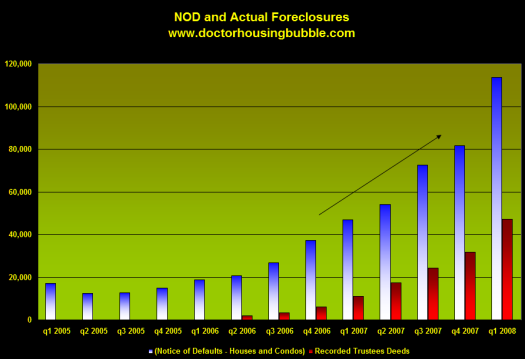
And here's showing how all of those subprime loans hit us at once:

In short, it takes more than 7 weeks to undo almost a decade of bad interbank lending. On that same coin, one could also say it would take more than a few billion (if it even would work), to save companies who have been sucking it up for almost 30 years. As for the total amount, everybody agrees it's hard to determine, because of the difficulting in evaluating the value of the toxic assets. Ultimately the free market will determine that.
Last edited by Dan Daly; Nov 28, 2008 at 12:16 AM.
Registered User
Joined: Mar 2005
Posts: 3,123
From: Melbourne, Australia
Well by your explanation, the bailout was pointless... b/c as you say the freemarket will ultimately determine the credit market's position.
Therefore, the bailout has not produced the desired result.
Therefore, the bailout has not produced the desired result.
Banned
Joined: Jun 2008
Posts: 167
From: USA
Uh, try reading all of that again. I did not say anything you just said I did.