


The Future....


Thread Starter
Registered User
Joined: Dec 2000
Posts: 284
From: Pa
The Future....
video.... of race...and one ugly little car...
http://jalopnik.com/5101963/tesla-sc...-car-drag-race
In what may be the first ever drag race between production electric cars, the geeky Tango electric cruiser edged out the trendy Tesla Roadster electric sports car. How fast were these electron-fueled warriors going when they crossed the finish line?
According to the person who posted the video, the Tango crossed the quarter mile in 14.48 seconds at a speed of 92.15 mph, besting the Tesla's 14.666 seconds at 101.23 miles.
On Nov 30th, the fastest production electric vehicles in the U.S. went head-to-head. While their first meeting had a number of issues, most notably the underfilled Tango battery pack, and the Tesla's non-upgraded drivetrain, the 1/4 mile time is quite close and indicative of races to come.
In this race, the Tango got 92.15mph in 14.480 seconds, beating its 14.7 "dial" handicap and thus losing the competition; the Tesla got 101.23mph in 14.666 seconds, slower than its 14.5 "dial" handicap and allowing it to proceed to the next round. (Two rounds later, the Tango's driver got behind the wheel of the Tesla and also beat its "dial" handicap... and thus lost!)
http://jalopnik.com/5101963/tesla-sc...-car-drag-race
In what may be the first ever drag race between production electric cars, the geeky Tango electric cruiser edged out the trendy Tesla Roadster electric sports car. How fast were these electron-fueled warriors going when they crossed the finish line?
According to the person who posted the video, the Tango crossed the quarter mile in 14.48 seconds at a speed of 92.15 mph, besting the Tesla's 14.666 seconds at 101.23 miles.
On Nov 30th, the fastest production electric vehicles in the U.S. went head-to-head. While their first meeting had a number of issues, most notably the underfilled Tango battery pack, and the Tesla's non-upgraded drivetrain, the 1/4 mile time is quite close and indicative of races to come.
In this race, the Tango got 92.15mph in 14.480 seconds, beating its 14.7 "dial" handicap and thus losing the competition; the Tesla got 101.23mph in 14.666 seconds, slower than its 14.5 "dial" handicap and allowing it to proceed to the next round. (Two rounds later, the Tango's driver got behind the wheel of the Tesla and also beat its "dial" handicap... and thus lost!)


Super Moderator
Joined: Jul 2005
Posts: 9,507
From: Okemos, MI
Ooooh, 14 second cars. 
I used to know a guy (haven't seen him since college) that worked for GM Ovonic, the company that was responsible for the battery in the Saturn EV1.
Apparently, they had prototype vehicles running the quarter mile in the 11-12 second range, although I'm sure their other attributes were not viable for a car to be sold to the public.
I used to know a guy (haven't seen him since college) that worked for GM Ovonic, the company that was responsible for the battery in the Saturn EV1.
Apparently, they had prototype vehicles running the quarter mile in the 11-12 second range, although I'm sure their other attributes were not viable for a car to be sold to the public.


Banned
Joined: Mar 2001
Posts: 1,938
Electric is not the future
I realize that almost all the vehicle manufacturers are rushing to get an electric vehicle to market…that it’s the “in” thing to be doing now; but if you are really looking toward the future; I don’t see electric vehicles ever being much more than a vehicle for daily commuting/grocery getters; and a fairly expensive option for those uses (even with mass production).
Looking back at the history of the automobile, it’s represented, especially in the U.S., far, far more than just transportation to/from work or running around town…it’s represented true freedom to travel almost anywhere…obviously; part of that is the distribution network of fuel.
In the desire to remove the U.S. from dependence on foreign sources of energy (i.e. crude oil), our one best domestic source of energy is natural gas…T. Boone Pickens has it right on this one.
Starting with commercial uses and then private sector, CNG is likely our best source of a extremely abundant and relatively inexpensive (compared to gasoline) source of energy and more importantly, it really doesn’t require a lot of changes for the automotive industry – most engines in every car on the road today could be converted to run on CNG and it wouldn’t take a lot of R&D to make an IC engine perform even better on CNG than a engine can on gasoline.
The only real drawback with CNG at the moment is a lack of refueling stations but that can be easily solved; much more easily solved, most likely, than building infrastructure for other substitutes.
Looking back at the history of the automobile, it’s represented, especially in the U.S., far, far more than just transportation to/from work or running around town…it’s represented true freedom to travel almost anywhere…obviously; part of that is the distribution network of fuel.
In the desire to remove the U.S. from dependence on foreign sources of energy (i.e. crude oil), our one best domestic source of energy is natural gas…T. Boone Pickens has it right on this one.
Starting with commercial uses and then private sector, CNG is likely our best source of a extremely abundant and relatively inexpensive (compared to gasoline) source of energy and more importantly, it really doesn’t require a lot of changes for the automotive industry – most engines in every car on the road today could be converted to run on CNG and it wouldn’t take a lot of R&D to make an IC engine perform even better on CNG than a engine can on gasoline.
The only real drawback with CNG at the moment is a lack of refueling stations but that can be easily solved; much more easily solved, most likely, than building infrastructure for other substitutes.

Registered User
Joined: Jan 2000
Posts: 10,285
From: Albany, NY
I realize that almost all the vehicle manufacturers are rushing to get an electric vehicle to market…that it’s the “in” thing to be doing now; but if you are really looking toward the future; I don’t see electric vehicles ever being much more than a vehicle for daily commuting/grocery getters; and a fairly expensive option for those uses (even with mass production).
Looking back at the history of the automobile, it’s represented, especially in the U.S., far, far more than just transportation to/from work or running around town…it’s represented true freedom to travel almost anywhere…obviously; part of that is the distribution network of fuel.
In the desire to remove the U.S. from dependence on foreign sources of energy (i.e. crude oil), our one best domestic source of energy is natural gas…T. Boone Pickens has it right on this one.
Starting with commercial uses and then private sector, CNG is likely our best source of a extremely abundant and relatively inexpensive (compared to gasoline) source of energy and more importantly, it really doesn’t require a lot of changes for the automotive industry – most engines in every car on the road today could be converted to run on CNG and it wouldn’t take a lot of R&D to make an IC engine perform even better on CNG than a engine can on gasoline.
The only real drawback with CNG at the moment is a lack of refueling stations but that can be easily solved; much more easily solved, most likely, than building infrastructure for other substitutes.
Looking back at the history of the automobile, it’s represented, especially in the U.S., far, far more than just transportation to/from work or running around town…it’s represented true freedom to travel almost anywhere…obviously; part of that is the distribution network of fuel.
In the desire to remove the U.S. from dependence on foreign sources of energy (i.e. crude oil), our one best domestic source of energy is natural gas…T. Boone Pickens has it right on this one.
Starting with commercial uses and then private sector, CNG is likely our best source of a extremely abundant and relatively inexpensive (compared to gasoline) source of energy and more importantly, it really doesn’t require a lot of changes for the automotive industry – most engines in every car on the road today could be converted to run on CNG and it wouldn’t take a lot of R&D to make an IC engine perform even better on CNG than a engine can on gasoline.
The only real drawback with CNG at the moment is a lack of refueling stations but that can be easily solved; much more easily solved, most likely, than building infrastructure for other substitutes.
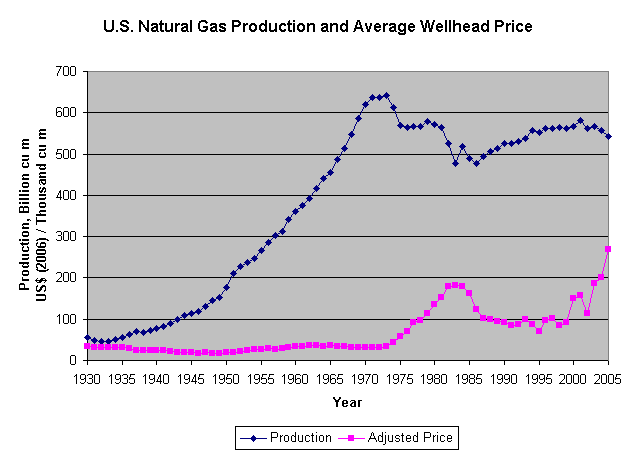
US gas production peak in the 70's and is on a slow decline. We move vehicles to CNG and in 5-10 years we will be no better off than we are today with oil.
If we truly do care about energy independence we will move toward electrified rail to replace trucking and electrify cars (start with plug in hybrids) as soon as we can. Building the grid to handle this needs to start now while we still have the means.

Last edited by Z28x; Dec 8, 2008 at 02:07 PM.
Banned
Joined: Mar 2001
Posts: 1,938
The smart thing to do would be too keep Natural Gas as a home heating and industrial feedstock only. Keep it as far away as possible transportation as possible.
US gas production peak in the 70's and is on a slow decline. We move vehicles to CNG and in 5-10 years we will be no better off than we are today with oil.
If we truly do care about energy independence we will move toward electrified rail to replace trucking and electrify cars (start with plug in hybrids) as soon as we can. Building the grid to handle this needs to start now while we still have the means.
US gas production peak in the 70's and is on a slow decline. We move vehicles to CNG and in 5-10 years we will be no better off than we are today with oil.
If we truly do care about energy independence we will move toward electrified rail to replace trucking and electrify cars (start with plug in hybrids) as soon as we can. Building the grid to handle this needs to start now while we still have the means.
Also, doing "one" doesn't mean we have to "not do" the other...we need to be doing a lot of different things (so long as they make economic sense).




Thread
Thread Starter
Forum
Replies
Last Post
CustomSSI
Supporting Vendor Group Purchases and Sales
2
Mar 25, 2006 08:28 PM
Aeromaks
LT1 Based Engine Tech
7
Nov 18, 2003 01:37 PM