


The Physics Of Throwing Rods


Thread Starter
Registered User
Joined: Jun 2004
Posts: 339
From: San Antonio, Texas
The Physics Of Throwing Rods
What is the likelyness that you will throw a rod from too much power, or should I say, from a compressive load? Ballpark figure, how much power is required to break a factory style connecting rod in this way?
As far as I know the typical failure from a connecting rod is a broken rod bolt, caused from an extreme tensile load. Aren't these inertial tensile loads caused by RPM only?
Is it possible that other parts of the connecting rod break from inertial tensile loads, and not the rod bolt? How common is this?
Is there such thing as a "compressive" tensile load? If so, when does a connecting rod experience this type of load?
A BIG THANKS in advance to all the engineers and engine experts on this site that make it KICK ***!! If you guys weren't here, it would be pointless for me to ask questions.
As far as I know the typical failure from a connecting rod is a broken rod bolt, caused from an extreme tensile load. Aren't these inertial tensile loads caused by RPM only?
Is it possible that other parts of the connecting rod break from inertial tensile loads, and not the rod bolt? How common is this?
Is there such thing as a "compressive" tensile load? If so, when does a connecting rod experience this type of load?
A BIG THANKS in advance to all the engineers and engine experts on this site that make it KICK ***!!
If you guys weren't here, it would be pointless for me to ask questions.

Registered User
Joined: Mar 2004
Posts: 132
From: Erie, PA
ive seen alot of engines break in that radius at the bottom by the rod bolts. a friend of mine works at my local asphalt track (Lake Erie Speedway) on the track clean up crew. he has brought home a couple factory rods that were run in the super stock class where they broke in that area. almost everyone i know runs ARP rod bolts and they dont generally break, its the radius that leads the rod bolts into the rod beam... i really cant explain what im thinking, i wish i had a picture. do you get the area of the rod im talking about? hope that helps!
*Eric*
*Eric*

Registered User
Joined: Oct 2002
Posts: 2,931
From: Upstate NY
Re: The Physics Of Throwing Rods
Originally posted by '68LT1camaro
What is the likelyness that you will throw a rod from too much power, or should I say, from a compressive load? Ballpark figure, how much power is required to break a factory style connecting rod in this way?
As far as I know the typical failure from a connecting rod is a broken rod bolt, caused from an extreme tensile load. Aren't these inertial tensile loads caused by RPM only?
Yes. Inertia loads, caused by rpm and reciprocating mass are the killers. Generally the rod bolts are the weak link, but if you strengthen them the next weak link, like Eric mentioned, will be the failure point. So, yes, other parts of the rod can fail in tension.
Is it possible that other parts of the connecting rod break from inertial tensile loads, and not the rod bolt? How common is this?
Is there such thing as a "compressive" tensile load? If so, when does a connecting rod experience this type of load?
Tensile is "pull-apart" loading and compression is "push-together" loading, so "compressive" tensile load probably isn't a good term. Max compressive loads are during the power stroke, and unless you are highly supercharged or have lots of nitrous, rods won't very often initiate failure in compression. Of course it the lower end distorts enough to wipe out the bearing and the rod "freezes" to the journal, the combination of compression and bending loads could fail it in the beam. Holing a piston or breaking a cylinder wall and sticking a piston in it can do the same thing. That might look like compressive load failure, but it's a result rather than a cause.
Most likely you will fail a stock-type rod in tension before you can load it enough in compression to fail it.
Max tensile loads are at the highest speed with the piston at the top of the stroke and the throttle closed. There is no compression to help offset the inertially caused tensile loads. A 9000 + rpm 3.25 stroke Nextel Cup engine sees about 5000 g's at the piston. A 19000 rpm F1 engine sees about 10,000g's! Keep those pistons light if you need to rev it!
My $.02
What is the likelyness that you will throw a rod from too much power, or should I say, from a compressive load? Ballpark figure, how much power is required to break a factory style connecting rod in this way?
As far as I know the typical failure from a connecting rod is a broken rod bolt, caused from an extreme tensile load. Aren't these inertial tensile loads caused by RPM only?
Yes. Inertia loads, caused by rpm and reciprocating mass are the killers. Generally the rod bolts are the weak link, but if you strengthen them the next weak link, like Eric mentioned, will be the failure point. So, yes, other parts of the rod can fail in tension.
Is it possible that other parts of the connecting rod break from inertial tensile loads, and not the rod bolt? How common is this?
Is there such thing as a "compressive" tensile load? If so, when does a connecting rod experience this type of load?
Tensile is "pull-apart" loading and compression is "push-together" loading, so "compressive" tensile load probably isn't a good term. Max compressive loads are during the power stroke, and unless you are highly supercharged or have lots of nitrous, rods won't very often initiate failure in compression. Of course it the lower end distorts enough to wipe out the bearing and the rod "freezes" to the journal, the combination of compression and bending loads could fail it in the beam. Holing a piston or breaking a cylinder wall and sticking a piston in it can do the same thing. That might look like compressive load failure, but it's a result rather than a cause.
Most likely you will fail a stock-type rod in tension before you can load it enough in compression to fail it.
Max tensile loads are at the highest speed with the piston at the top of the stroke and the throttle closed. There is no compression to help offset the inertially caused tensile loads. A 9000 + rpm 3.25 stroke Nextel Cup engine sees about 5000 g's at the piston. A 19000 rpm F1 engine sees about 10,000g's! Keep those pistons light if you need to rev it!
My $.02

Registered User
Joined: Mar 2000
Posts: 2,037
From: 51°N 114°W, 3500' elevation
Under compression, a piston and rod are forced down onto the crank. There's never a problems there. It's when the piston and rod are moving being forced back up into the cylinder then suddenly stop at the top before moving back down that problems occur. There's a lot of weight being stopped and the only thing keeping the piston from continuing up to smack the head are the rod bolts.
The faster the engine revs, the quicker the piston speed is. Faster speed with a heavy weight requires more clamping force.
Out of all the fasteners in the engine, I'd recommend using ARP rod bolts the most. Mains and head bolts are nice but don't see the same stresses as rod bolts.
The faster the engine revs, the quicker the piston speed is. Faster speed with a heavy weight requires more clamping force.
Out of all the fasteners in the engine, I'd recommend using ARP rod bolts the most. Mains and head bolts are nice but don't see the same stresses as rod bolts.
Thread Starter
Registered User
Joined: Jun 2004
Posts: 339
From: San Antonio, Texas
So based on these answers, is it safe to say that a high horse power street engine that will never see above 6000 RPM (EXAMPLE: centrifigul supercharged street engine making 700 crank HP @6000RPM) shouldn't need much more than a stock rod, free of cracks, with ARP rod bolts?

Banned
Joined: Nov 2003
Posts: 1,211
As long as you stay away from detonation, then yes... the chances of your rods failing go down as your RPMs go down.
I have no idea if it's a linear or exponential relationship, and I'm not sure that anyone has bothered to find out.
I do know that Smokey talks about the sharp "waves" from detonation traveling through the rod, hittin g the bearing, making the ends pull in, which scrapes oil off the journal and then bad things happen.
I would say, based upon the reading I've done and the experience I've had (including blown motors, unfortunately) leads me to believe that you're far better off worrying about avoiding detonation.
I have no idea if it's a linear or exponential relationship, and I'm not sure that anyone has bothered to find out.
I do know that Smokey talks about the sharp "waves" from detonation traveling through the rod, hittin g the bearing, making the ends pull in, which scrapes oil off the journal and then bad things happen.
I would say, based upon the reading I've done and the experience I've had (including blown motors, unfortunately) leads me to believe that you're far better off worrying about avoiding detonation.

Registered User
Joined: Jun 2003
Posts: 584
I am interested in this as well. I currently am running the GM forged PM rods, rated to 500 hp in summit. I would imagine in a motor that isnt spinning more than 6500 rpm they could take quite some abuse. Anyone have any experience with these?
Thread Starter
Registered User
Joined: Jun 2004
Posts: 339
From: San Antonio, Texas
I have a friend that works at a race shop here in town. He has a destroked 400 (377 cubic inch small block) that he spins to 8000 RPM's and higher! NO BS! This motor is in his DAILY DRIVEN '63 Nova. (I think its a '63) He is using a factory 350 steel crankshaft with Eagle H-beam rods. I'm not sure what brand pistons. I think JE. The car runs consistant 10.40's at the track, naturally aspirated. No nitrous.
He says it's overkill to buy high dollar race parts for low RPM street engines. He said it's very common for them to use a crank rated to 800 HP in a 2000 HP race motor. He said of more importance than high dollar parts, is good quality machine work, balancing, and proper engine assembly.
I'd like as many opinions on this subject as possible. I really appreciate your replys. THANKS!!
He says it's overkill to buy high dollar race parts for low RPM street engines. He said it's very common for them to use a crank rated to 800 HP in a 2000 HP race motor. He said of more importance than high dollar parts, is good quality machine work, balancing, and proper engine assembly.
I'd like as many opinions on this subject as possible. I really appreciate your replys. THANKS!!
Registered User
Joined: Mar 2004
Posts: 132
From: Erie, PA
Originally posted by '68LT1camaro
breakthelawinaz,
When refering to the breakage prone area, do you mean the rod cap, or the area between the cap and the beam?
breakthelawinaz,
When refering to the breakage prone area, do you mean the rod cap, or the area between the cap and the beam?
*eric*
EDIT: found one...
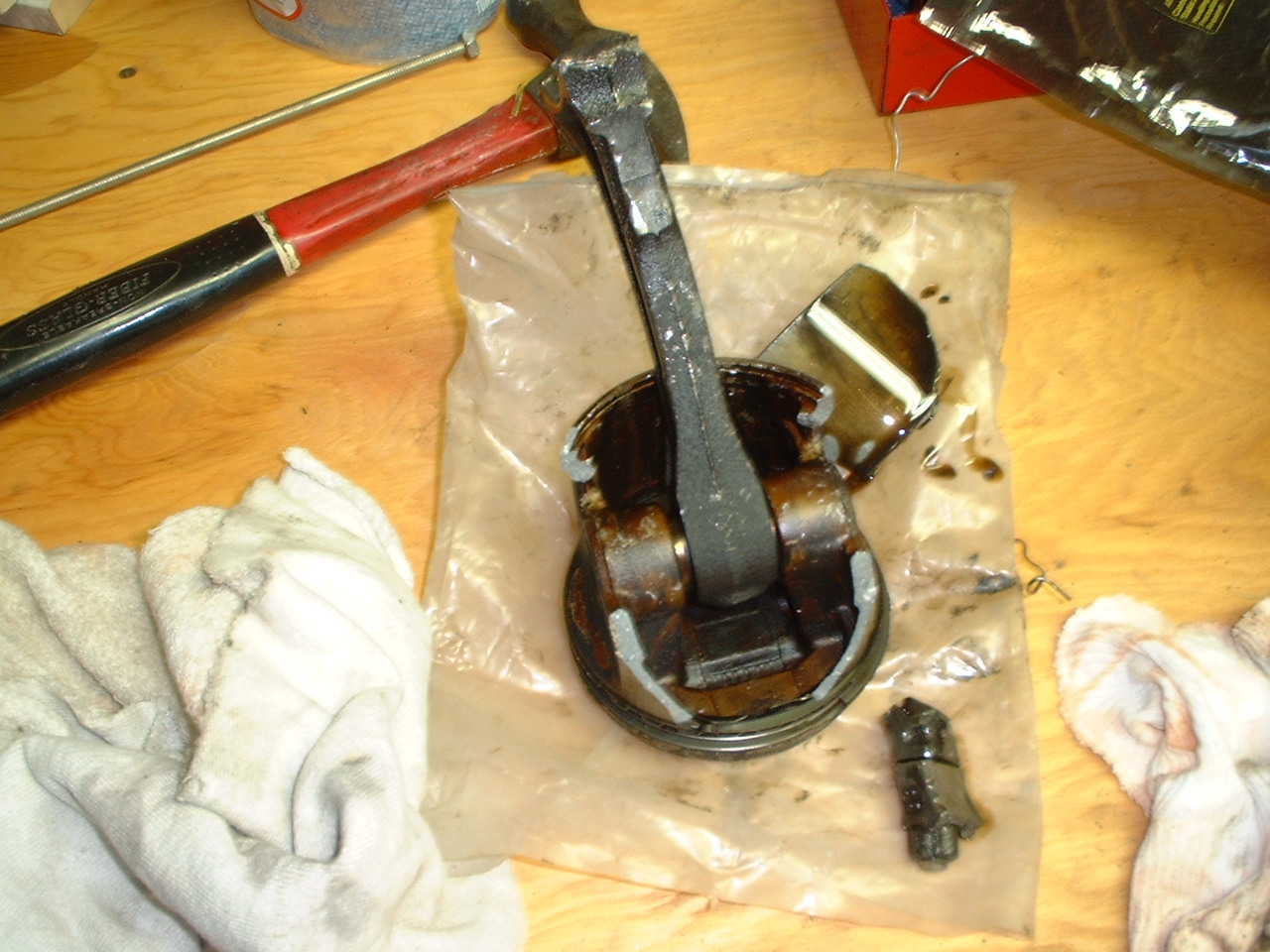
this is a buick rod. if you look at the rod it broke on both sides just above the bolt. that was the area i was referring to, the place where it is spot faced so i guess it would be the area between the cap and the beam to answer your question 68LT1camaro. if you look to the right of the piston you can actually see the rod bolt still in one piece with the rod pieces on it!
pretty crazy...
Last edited by breakthelawinaz; Jun 15, 2004 at 06:35 AM.
Registered User
Joined: Oct 2002
Posts: 2,931
From: Upstate NY
Originally posted by '68LT1camaro
So based on these answers, is it safe to say that a high horse power street engine that will never see above 6000 RPM (EXAMPLE: centrifigul supercharged street engine making 700 crank HP @6000RPM) shouldn't need much more than a stock rod, free of cracks, with ARP rod bolts?
So based on these answers, is it safe to say that a high horse power street engine that will never see above 6000 RPM (EXAMPLE: centrifigul supercharged street engine making 700 crank HP @6000RPM) shouldn't need much more than a stock rod, free of cracks, with ARP rod bolts?
IMO, no, a stock rod is inadequate. Here's why.
700 hp at 6000 implies LOTS of cylinder pressure, and probably borderline detonation. To handle those piston loads, the piston needs to be very strong, which means quite heavy which increases the tensile loads in the rod dramatically even at 6000 when you lift to shift or pass the lights.
That's at least twice the hp the rod was designed to take. That means the stress applied each revolution is closer to the rod's limit for durability. Steel can have almost an inifnite life if the stresses applied stay below a certain level. As you raise the level of stress (hp), the life gets shorter. At the extreme, given enough load (stress), the part will fail the first time the load is applied.
Trying to reuse stock rods in this application is false economy. You will probably fail a rod and then "run over your crank" so it's going to cost lots more than just rods. For a few hundred $ more, probably less than 4% of the total cost for this 700 hp engine, or any 500+ hp engine for that matter, you can buy good new rods which will be adequate without being extravagant.
As far as used rods, remember that steel, like a woman, remembers every stress ever applied to it. When the final stress is applied that will overtax the system, failure can be explosive. You never know when it will occur.
Obviously if you are building your own 700 hp 6000 rpm blown engine you can choose any parts you want. However most professional engine builders wouldn't use stock rods in this application. That's probably a conservative estimate.
My $02. Your opinion may vary.
Last edited by OldSStroker; Jun 15, 2004 at 01:52 PM.

Thread Starter
Registered User
Joined: Jun 2004
Posts: 339
From: San Antonio, Texas
I'm running a 350 cubic inch LT1 with an S-trim Vortech. I'm running 11 pounds of boost, and two air to air intercoolers run in parallel. I have 3" dual exhaust. Hedman full length headers and some 40 series FlowMasters. I have an Accel gen 7 DFI engine management set up with 48 pound per hour injectors.
My goal is 600 HP at the crank with the blower. Then 700 at the crank with some nitrous. I still have some things I need to do to the motor to get it there. (ported heads, custom blower cam, more boost, the usual stuff)
In the short block I have an Eagle cast steel crank, Eagle "SIR" I-beam connecting rods with ARP wave locs, and SPEED PRO forged dished pistons. Everything is brand new, and balanced. My compression is right around 9.0 to 1 with these pistons. (21 cc dish) I'm using ARP head and main studs.
You guys think this short block will hold together for a while with 700 at the crank? Should I forget the nitrous, and keep the goal at 600 HP?
What should I upgrade to keep the short block alive, if you don't think this is a good combonation?
My goal is 600 HP at the crank with the blower. Then 700 at the crank with some nitrous. I still have some things I need to do to the motor to get it there. (ported heads, custom blower cam, more boost, the usual stuff)
In the short block I have an Eagle cast steel crank, Eagle "SIR" I-beam connecting rods with ARP wave locs, and SPEED PRO forged dished pistons. Everything is brand new, and balanced. My compression is right around 9.0 to 1 with these pistons. (21 cc dish) I'm using ARP head and main studs.
You guys think this short block will hold together for a while with 700 at the crank? Should I forget the nitrous, and keep the goal at 600 HP?
What should I upgrade to keep the short block alive, if you don't think this is a good combonation?

Registered User
Joined: Aug 1998
Posts: 520
From: Perryopolis, Pa
Personally I would hold off on the nitrous.
You are pushing the combination pretty hard with the charger at 11#.
Your bottom end combination may live a long happy life, but I would not use these components if I had to build a customers engine.
My opinion is your crank, rods & piston choice would stop me at a 500hp safety level. I would say it should be ok with another 100hp, but would not stake my reputation on it. I have also used a stock crank & rods at the 600hp level (in a previous car of mine)without problem, but did so for my own use.
With nitrous on top, I would definitely plan on some more serious components.
You are pushing the combination pretty hard with the charger at 11#.
Your bottom end combination may live a long happy life, but I would not use these components if I had to build a customers engine.
My opinion is your crank, rods & piston choice would stop me at a 500hp safety level. I would say it should be ok with another 100hp, but would not stake my reputation on it. I have also used a stock crank & rods at the 600hp level (in a previous car of mine)without problem, but did so for my own use.
With nitrous on top, I would definitely plan on some more serious components.