


Timing on carbed 350


Thread Starter
Registered User
Joined: Jun 2003
Posts: 287
From: Pensacola, FL
Timing on carbed 350
I'm trying to set the timing on a carbed 350, and I know they like 6* stock, 12-18* for a performance setup (initial timing). I pulled off the vacuum advance and checked the initial at idle (~900 RPM). It idles at 34* and seems like it's too far retarded. I'm getting knock and it's heating up real fast. When I rev it up a bit, it was at 45* (~1800 RPM). It's the stock non-CC distributor and I believe it's installed on the right tooth because the vacuum canister is pointing toward the passenger front tire and the coil is at about a 90* angle with the longitudinal axis with the connectors pointing toward the driver side. Am I off a tooth or what gives? Does a hotcam like this much initial timing? 

Thread Starter
Registered User
Joined: Jun 2003
Posts: 287
From: Pensacola, FL
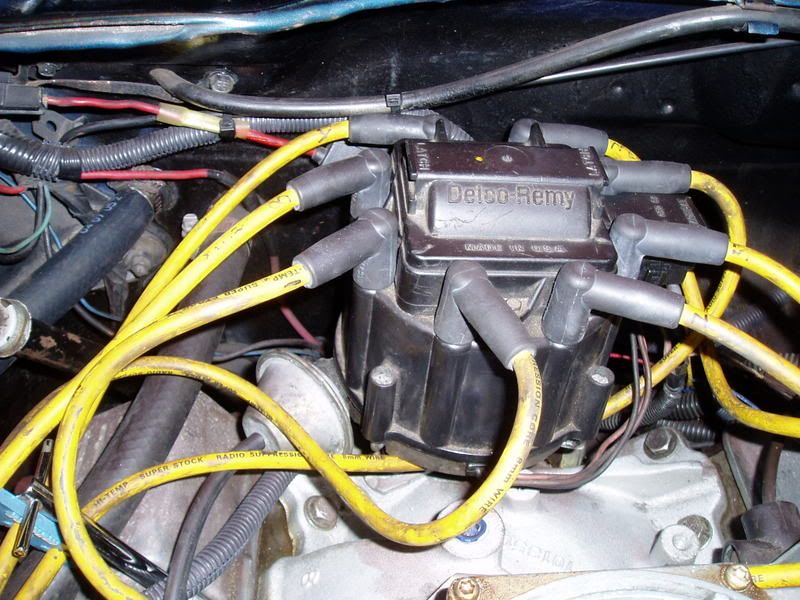
OK, I don't know what gives here. Here's the distributor from the front of the engine. The firing order as on the cap is 1-8-4-3-6-5-7-2. #1 is on the bottom of the left side, and it goes clockwise from there. At idle, I have 34* advance, and it goes up from there. I also have a knock at idle but it goes away with higher RPM. Any advice?

Registered User
Joined: Sep 1999
Posts: 2,342
From: MI
What about loosening the hold down and backing it down? Did you install it properly with the #1 cyl at top dead center and the distributor rotor pointing towards that #1 cyl? (actually it will point just in between 1 and 3. ) Looks like 5 o'clock from above. I have mine locked at 38 degrees from idle and at wide open throttle but you would be better off with 12-14 initial and the vac advance should add 20 degrees to that for the total.

Registered User
Joined: Apr 2006
Posts: 41
From: China now, Originally from Iowa, then worked in California
SBC basics, Number 1 post on the cap is supposed to point basically at the number one cylinder. #1 is front of car on driver's side. #2 is on passenger side.
Install distributor with #1 cylinder at Top Dead Center (TDC) on compression stroke (turn engine by (friend's) hand, and feel in the spark plug hole for air pushing out hard (or have valve cover off, and see that both valves are closed on number 1). With engine at TDC #1, drop distributor in (aim for rotor to point at number one cylinder), and make sure the oil pump shaft engages. Can either turn engine BY HAND until oil pump engages (allows distributor to seat fully), or lift distributor out enough to rotate, re-drop, and repeat until it can drop all the way in. Then, once shaft is engaged, you repeat, but be careful to not lift too far, and get rotor pointed back to #1 cylinder, and make sure it can still drop in. Then, lightly lock distributor in place (observe the gasket area, and make sure it's fully seated). Start engine (rotate a little if can't start). Set timing, tighten the lock down clamp.
Wide Open Throttle (WOT) timing is most critical. A typical value to start with is 32 degrees. Set this with vacuum advance DISCONNECTED, and hold engine RPMs at about 3000 or more.
Reconnect vacuum advance. Drive, check for ping or knock at WOT with warm engine. Go to chassis dyno or drag strip, and tune for best performance without knock.
When WOT is set, write down that value. Also note what idle advance (without vacuum advance) delivers that WOT advance. (subtract from WOT, and you'll now know your mechanical advance).
Note how well the engine idles. Bigger cams want more idle advance and low RPM advance, but you have to balance the mechanical advance rate and amount. A spring and weight kit can allow you to taylor your spark curve for best idle, low RPM timing, and power. Vacuum advance can be enabled at idle as well, if it doesn't cause tip-in knock (but this may indicate your mechanical advance is not ideal). Vacuum advance should be used for street driving if you desire better fuel economy, as it gives more advance at light throttle. How much? ~8-10 degrees or so.
Install distributor with #1 cylinder at Top Dead Center (TDC) on compression stroke (turn engine by (friend's) hand, and feel in the spark plug hole for air pushing out hard (or have valve cover off, and see that both valves are closed on number 1). With engine at TDC #1, drop distributor in (aim for rotor to point at number one cylinder), and make sure the oil pump shaft engages. Can either turn engine BY HAND until oil pump engages (allows distributor to seat fully), or lift distributor out enough to rotate, re-drop, and repeat until it can drop all the way in. Then, once shaft is engaged, you repeat, but be careful to not lift too far, and get rotor pointed back to #1 cylinder, and make sure it can still drop in. Then, lightly lock distributor in place (observe the gasket area, and make sure it's fully seated). Start engine (rotate a little if can't start). Set timing, tighten the lock down clamp.
Wide Open Throttle (WOT) timing is most critical. A typical value to start with is 32 degrees. Set this with vacuum advance DISCONNECTED, and hold engine RPMs at about 3000 or more.
Reconnect vacuum advance. Drive, check for ping or knock at WOT with warm engine. Go to chassis dyno or drag strip, and tune for best performance without knock.
When WOT is set, write down that value. Also note what idle advance (without vacuum advance) delivers that WOT advance. (subtract from WOT, and you'll now know your mechanical advance).
Note how well the engine idles. Bigger cams want more idle advance and low RPM advance, but you have to balance the mechanical advance rate and amount. A spring and weight kit can allow you to taylor your spark curve for best idle, low RPM timing, and power. Vacuum advance can be enabled at idle as well, if it doesn't cause tip-in knock (but this may indicate your mechanical advance is not ideal). Vacuum advance should be used for street driving if you desire better fuel economy, as it gives more advance at light throttle. How much? ~8-10 degrees or so.

Thread
Thread Starter
Forum
Replies
Last Post