


turbo vs. supercharger(LT1)


Thread Starter
Registered User
Joined: May 2006
Posts: 592
From: new orleans, la
turbo vs. supercharger(LT1)
Given a boost vs. boost all-out 1/4 drag race or straight-away, which would do better(hp wise): turbo or SC'er? I mean X psi on a turbo vs. X psi on a SC'er, which would yield more usable rpm power( up to 6500)? I know its a general question, but a turbo(that I'd want)+ install would be about 10k. A SC'er would be about $6500. Big difference. I'm weighing my options on FI. Don't want to start any arguing or debating, just want to hear options and experiences. Thanks.


Registered User
Joined: Jan 2007
Posts: 73
Short and light:
Ignoring differences among manufacturer compressor design and materials, the most notable difference between a belt-driven centrifugal supercharger and turbocharger (or turbo-supercharger) is the drive technology. Unlike roots or displacement superchargers, centrifugal superchargers have a boost curve very similar to a parabola—that is, a square function. Our engines have a linear air consumption curve because they are like roots blowers, displacement pumps, which can be modeled as linear function. When you gear your procharger (belt-driven centrifugal supercharger) to produce 20 pounds of boost at 6500 crank RPM, the boost curve is static in relation to crank speed. However, a turbo-supercharger has the advantage of a severely overdriven gear system—the turbine half in the exhaust system. The turbine can be controlled dynamically with the wastegate and thus acts as quite a wonderful transmission.
There are some caveats to be aware of when using a turbo-supercharger. Along with this wonderful transmission comes several unsuitable such as lag. When you chose a turbo, you must size the housing and wheel according to the desired gearing you wish to achieve—where and when do you want your power? With a larger wheel and housing, more air flow is required to initiate the turbine, "spool." The engine will require more RPM and or load to spool the turbo but exhaust back pressure will decrease and reduce work done by the engine to make net crank power. Sometimes, a smaller hot-side will be faster at the track because of this virtual gearing, but that is only in the case of a previous choice that was overzealous. In my opinion, lag is a phrase used by people who are not current with turbocharger technology and, to be frank, simply don't understand it. Huge turbochargers on tiny four-bangers were naturally predisposed to lag, but you cannot forget their innately large RPM range; large RPM range alone will result in lag with a unit sized for the top of the RPM range.
Getting down to power, the turbine drive method generally creates more torque (and usually a broad, flat torque curve at that) due to the pressure it invokes on the exhaust cycle and the fact that once spooled, many turbochargers can produce full boost at rather moderate RPM. This almost mimics the displacement type blowers. But, all of this power can also make for a slower car at the track. With so much power so soon, launching a turbo car can get extremely hairy. When the turbo lights off and accelerates the car, wheel spin can become uncontrollable and deadly to your short times.
I am the biggest fan of turbochargers and am the first to call out the purveyors of anti-turbo dogma, but given the under-hood layout of a fourth-gen and intended use, it really is hard to beat the larger belt-driven centrifugal superchargers from ATI and Vortech. Some people also value that whine to attract attention from all performance car people—you will definitely find others noticing.
Ignoring differences among manufacturer compressor design and materials, the most notable difference between a belt-driven centrifugal supercharger and turbocharger (or turbo-supercharger) is the drive technology. Unlike roots or displacement superchargers, centrifugal superchargers have a boost curve very similar to a parabola—that is, a square function. Our engines have a linear air consumption curve because they are like roots blowers, displacement pumps, which can be modeled as linear function. When you gear your procharger (belt-driven centrifugal supercharger) to produce 20 pounds of boost at 6500 crank RPM, the boost curve is static in relation to crank speed. However, a turbo-supercharger has the advantage of a severely overdriven gear system—the turbine half in the exhaust system. The turbine can be controlled dynamically with the wastegate and thus acts as quite a wonderful transmission.
There are some caveats to be aware of when using a turbo-supercharger. Along with this wonderful transmission comes several unsuitable such as lag. When you chose a turbo, you must size the housing and wheel according to the desired gearing you wish to achieve—where and when do you want your power? With a larger wheel and housing, more air flow is required to initiate the turbine, "spool." The engine will require more RPM and or load to spool the turbo but exhaust back pressure will decrease and reduce work done by the engine to make net crank power. Sometimes, a smaller hot-side will be faster at the track because of this virtual gearing, but that is only in the case of a previous choice that was overzealous. In my opinion, lag is a phrase used by people who are not current with turbocharger technology and, to be frank, simply don't understand it. Huge turbochargers on tiny four-bangers were naturally predisposed to lag, but you cannot forget their innately large RPM range; large RPM range alone will result in lag with a unit sized for the top of the RPM range.
Getting down to power, the turbine drive method generally creates more torque (and usually a broad, flat torque curve at that) due to the pressure it invokes on the exhaust cycle and the fact that once spooled, many turbochargers can produce full boost at rather moderate RPM. This almost mimics the displacement type blowers. But, all of this power can also make for a slower car at the track. With so much power so soon, launching a turbo car can get extremely hairy. When the turbo lights off and accelerates the car, wheel spin can become uncontrollable and deadly to your short times.
I am the biggest fan of turbochargers and am the first to call out the purveyors of anti-turbo dogma, but given the under-hood layout of a fourth-gen and intended use, it really is hard to beat the larger belt-driven centrifugal superchargers from ATI and Vortech. Some people also value that whine to attract attention from all performance car people—you will definitely find others noticing.


Registered User
Joined: Oct 2002
Posts: 1,194
From: Albuquerque, NM.
Short and light:
Ignoring differences among manufacturer compressor design and materials, the most notable difference between a belt-driven centrifugal supercharger and turbocharger (or turbo-supercharger) is the drive technology. Unlike roots or displacement superchargers, centrifugal superchargers have a boost curve very similar to a parabola—that is, a square function. Our engines have a linear air consumption curve because they are like roots blowers, displacement pumps, which can be modeled as linear function. When you gear your procharger (belt-driven centrifugal supercharger) to produce 20 pounds of boost at 6500 crank RPM, the boost curve is static in relation to crank speed. However, a turbo-supercharger has the advantage of a severely overdriven gear system—the turbine half in the exhaust system. The turbine can be controlled dynamically with the wastegate and thus acts as quite a wonderful transmission.
There are some caveats to be aware of when using a turbo-supercharger. Along with this wonderful transmission comes several unsuitable such as lag. When you chose a turbo, you must size the housing and wheel according to the desired gearing you wish to achieve—where and when do you want your power? With a larger wheel and housing, more air flow is required to initiate the turbine, "spool." The engine will require more RPM and or load to spool the turbo but exhaust back pressure will decrease and reduce work done by the engine to make net crank power. Sometimes, a smaller hot-side will be faster at the track because of this virtual gearing, but that is only in the case of a previous choice that was overzealous. In my opinion, lag is a phrase used by people who are not current with turbocharger technology and, to be frank, simply don't understand it. Huge turbochargers on tiny four-bangers were naturally predisposed to lag, but you cannot forget their innately large RPM range; large RPM range alone will result in lag with a unit sized for the top of the RPM range.
Getting down to power, the turbine drive method generally creates more torque (and usually a broad, flat torque curve at that) due to the pressure it invokes on the exhaust cycle and the fact that once spooled, many turbochargers can produce full boost at rather moderate RPM. This almost mimics the displacement type blowers. But, all of this power can also make for a slower car at the track. With so much power so soon, launching a turbo car can get extremely hairy. When the turbo lights off and accelerates the car, wheel spin can become uncontrollable and deadly to your short times.
I am the biggest fan of turbochargers and am the first to call out the purveyors of anti-turbo dogma, but given the under-hood layout of a fourth-gen and intended use, it really is hard to beat the larger belt-driven centrifugal superchargers from ATI and Vortech. Some people also value that whine to attract attention from all performance car people—you will definitely find others noticing.
Ignoring differences among manufacturer compressor design and materials, the most notable difference between a belt-driven centrifugal supercharger and turbocharger (or turbo-supercharger) is the drive technology. Unlike roots or displacement superchargers, centrifugal superchargers have a boost curve very similar to a parabola—that is, a square function. Our engines have a linear air consumption curve because they are like roots blowers, displacement pumps, which can be modeled as linear function. When you gear your procharger (belt-driven centrifugal supercharger) to produce 20 pounds of boost at 6500 crank RPM, the boost curve is static in relation to crank speed. However, a turbo-supercharger has the advantage of a severely overdriven gear system—the turbine half in the exhaust system. The turbine can be controlled dynamically with the wastegate and thus acts as quite a wonderful transmission.
There are some caveats to be aware of when using a turbo-supercharger. Along with this wonderful transmission comes several unsuitable such as lag. When you chose a turbo, you must size the housing and wheel according to the desired gearing you wish to achieve—where and when do you want your power? With a larger wheel and housing, more air flow is required to initiate the turbine, "spool." The engine will require more RPM and or load to spool the turbo but exhaust back pressure will decrease and reduce work done by the engine to make net crank power. Sometimes, a smaller hot-side will be faster at the track because of this virtual gearing, but that is only in the case of a previous choice that was overzealous. In my opinion, lag is a phrase used by people who are not current with turbocharger technology and, to be frank, simply don't understand it. Huge turbochargers on tiny four-bangers were naturally predisposed to lag, but you cannot forget their innately large RPM range; large RPM range alone will result in lag with a unit sized for the top of the RPM range.
Getting down to power, the turbine drive method generally creates more torque (and usually a broad, flat torque curve at that) due to the pressure it invokes on the exhaust cycle and the fact that once spooled, many turbochargers can produce full boost at rather moderate RPM. This almost mimics the displacement type blowers. But, all of this power can also make for a slower car at the track. With so much power so soon, launching a turbo car can get extremely hairy. When the turbo lights off and accelerates the car, wheel spin can become uncontrollable and deadly to your short times.
I am the biggest fan of turbochargers and am the first to call out the purveyors of anti-turbo dogma, but given the under-hood layout of a fourth-gen and intended use, it really is hard to beat the larger belt-driven centrifugal superchargers from ATI and Vortech. Some people also value that whine to attract attention from all performance car people—you will definitely find others noticing.
 Well put though and true. I'm nice and smooth out of the hole at the track even with nitrous on my setup. My buddies turbo mustang on the other hand is just plain crazy to watch when that thing really comes into it's boost, and we're making pretty similar peak rwhp. He's definitly got me on torque though boost for boost.
Ken R.

Registered User
Joined: Mar 2003
Posts: 390
From: Huntsville, AL
Short and light:
Ignoring differences among manufacturer compressor design and materials, the most notable difference between a belt-driven centrifugal supercharger and turbocharger (or turbo-supercharger) is the drive technology. Unlike roots or displacement superchargers, centrifugal superchargers have a boost curve very similar to a parabola—that is, a square function. Our engines have a linear air consumption curve because they are like roots blowers, displacement pumps, which can be modeled as linear function. When you gear your procharger (belt-driven centrifugal supercharger) to produce 20 pounds of boost at 6500 crank RPM, the boost curve is static in relation to crank speed. However, a turbo-supercharger has the advantage of a severely overdriven gear system—the turbine half in the exhaust system. The turbine can be controlled dynamically with the wastegate and thus acts as quite a wonderful transmission.
There are some caveats to be aware of when using a turbo-supercharger. Along with this wonderful transmission comes several unsuitable such as lag. When you chose a turbo, you must size the housing and wheel according to the desired gearing you wish to achieve—where and when do you want your power? With a larger wheel and housing, more air flow is required to initiate the turbine, "spool." The engine will require more RPM and or load to spool the turbo but exhaust back pressure will decrease and reduce work done by the engine to make net crank power. Sometimes, a smaller hot-side will be faster at the track because of this virtual gearing, but that is only in the case of a previous choice that was overzealous. In my opinion, lag is a phrase used by people who are not current with turbocharger technology and, to be frank, simply don't understand it. Huge turbochargers on tiny four-bangers were naturally predisposed to lag, but you cannot forget their innately large RPM range; large RPM range alone will result in lag with a unit sized for the top of the RPM range.
Getting down to power, the turbine drive method generally creates more torque (and usually a broad, flat torque curve at that) due to the pressure it invokes on the exhaust cycle and the fact that once spooled, many turbochargers can produce full boost at rather moderate RPM. This almost mimics the displacement type blowers. But, all of this power can also make for a slower car at the track. With so much power so soon, launching a turbo car can get extremely hairy. When the turbo lights off and accelerates the car, wheel spin can become uncontrollable and deadly to your short times.
I am the biggest fan of turbochargers and am the first to call out the purveyors of anti-turbo dogma, but given the under-hood layout of a fourth-gen and intended use, it really is hard to beat the larger belt-driven centrifugal superchargers from ATI and Vortech. Some people also value that whine to attract attention from all performance car people—you will definitely find others noticing.
Ignoring differences among manufacturer compressor design and materials, the most notable difference between a belt-driven centrifugal supercharger and turbocharger (or turbo-supercharger) is the drive technology. Unlike roots or displacement superchargers, centrifugal superchargers have a boost curve very similar to a parabola—that is, a square function. Our engines have a linear air consumption curve because they are like roots blowers, displacement pumps, which can be modeled as linear function. When you gear your procharger (belt-driven centrifugal supercharger) to produce 20 pounds of boost at 6500 crank RPM, the boost curve is static in relation to crank speed. However, a turbo-supercharger has the advantage of a severely overdriven gear system—the turbine half in the exhaust system. The turbine can be controlled dynamically with the wastegate and thus acts as quite a wonderful transmission.
There are some caveats to be aware of when using a turbo-supercharger. Along with this wonderful transmission comes several unsuitable such as lag. When you chose a turbo, you must size the housing and wheel according to the desired gearing you wish to achieve—where and when do you want your power? With a larger wheel and housing, more air flow is required to initiate the turbine, "spool." The engine will require more RPM and or load to spool the turbo but exhaust back pressure will decrease and reduce work done by the engine to make net crank power. Sometimes, a smaller hot-side will be faster at the track because of this virtual gearing, but that is only in the case of a previous choice that was overzealous. In my opinion, lag is a phrase used by people who are not current with turbocharger technology and, to be frank, simply don't understand it. Huge turbochargers on tiny four-bangers were naturally predisposed to lag, but you cannot forget their innately large RPM range; large RPM range alone will result in lag with a unit sized for the top of the RPM range.
Getting down to power, the turbine drive method generally creates more torque (and usually a broad, flat torque curve at that) due to the pressure it invokes on the exhaust cycle and the fact that once spooled, many turbochargers can produce full boost at rather moderate RPM. This almost mimics the displacement type blowers. But, all of this power can also make for a slower car at the track. With so much power so soon, launching a turbo car can get extremely hairy. When the turbo lights off and accelerates the car, wheel spin can become uncontrollable and deadly to your short times.
I am the biggest fan of turbochargers and am the first to call out the purveyors of anti-turbo dogma, but given the under-hood layout of a fourth-gen and intended use, it really is hard to beat the larger belt-driven centrifugal superchargers from ATI and Vortech. Some people also value that whine to attract attention from all performance car people—you will definitely find others noticing.

Registered User
Joined: Dec 2005
Posts: 496
From: Wyoming
Turbo jsut cost a lot more than a supercharger.

Registered User
Joined: Feb 2003
Posts: 595
From: Michigan
Your right, turbos can be easy to install. But with superchargers you don't have to mess with the exhaust: headers, downpipe, crossover etc. You basically just bolt it on and go which saves a lot of time and hassle.
Registered User
Joined: Jan 2007
Posts: 73
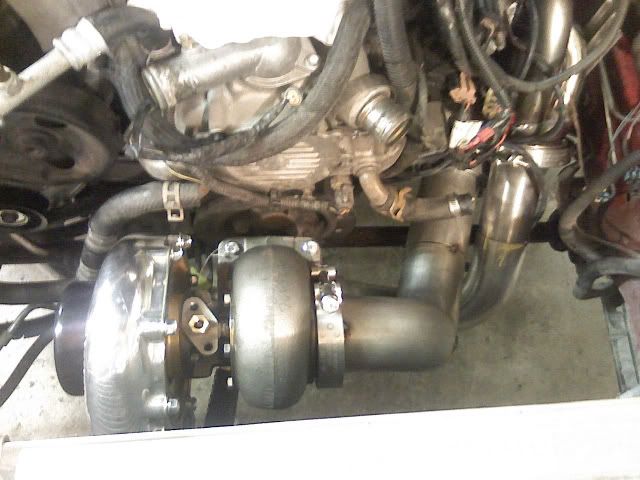
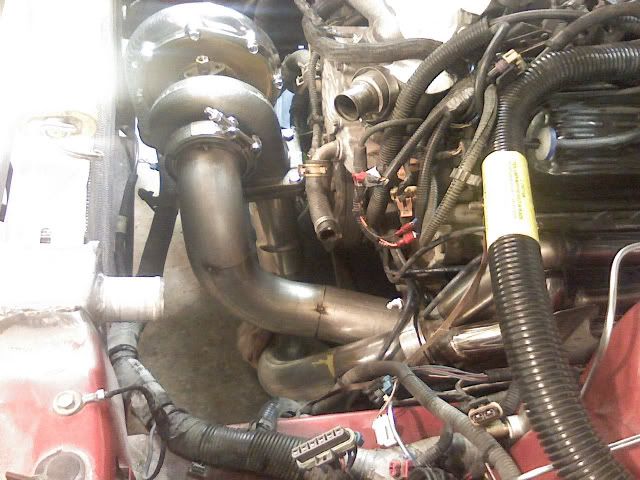
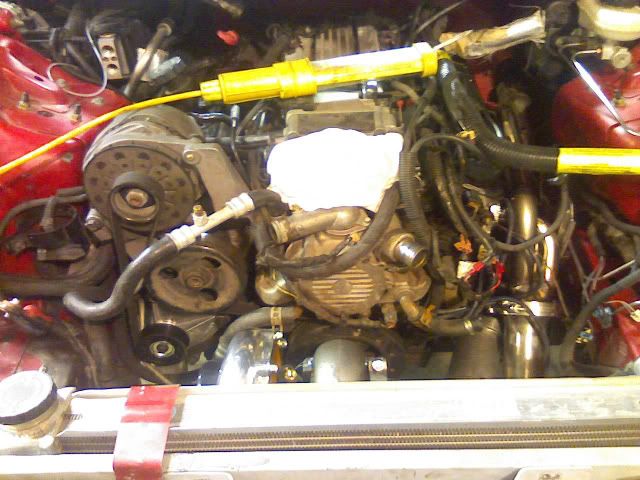
Forget the installation, turbos are usually just a general pain in the **** to work on in a fourth-generation F-body. Difficult? No, but there are many more constraints on the design of a turbo system than belt driven supercharger. For the mechanic, this means there will be many tight spots you need to put a hand, ratchet, extension, washer, and bolt through, in the same movement.

Registered User
Joined: Oct 2002
Posts: 2,277
From: Orange Kounty, Kalifornia
I live in the lame state of Kalifornia and we are discouraged from turbos since they are not CARB approved. Turbos can put down the power and Corky Bell has a great book you may be interested in.

Registered User
Joined: Nov 2005
Posts: 69
10k installed that seems wayyyyy to steep price alone id go supercharger. BTW i have a front mount turbo installed and tuned for 4k found a great deal and have had no problems so far(on a pretty much stock car) which im about to start putting the rest together.

Thread
Thread Starter
Forum
Replies
Last Post
dbusch22
Forced Induction
6
Oct 31, 2016 11:09 AM
Caps94ZODG
Automotive News / Industry / Future Vehicle Discussion
22
Jul 30, 2002 08:45 AM